
I am a little over 200 pages into the memoir, and there are only about 70 pages left. I just read where Dick Van Dyke’s father had just been diagnosed with emphysemia, and the doctor had told him, “You’re an old man, and your going to die.” Apparently the doctor had told him this as bluntly as I just wrote the prognosis and this had left Dick’s father and mother crying together in the hospital when Dick arrived. Dick said he ran around the hospital screaming and wanting to beat the crap out of this doctor. I closed the book, returned it to my little basket by my toilet and got up to wash my hands.
As I’m washing my hands, I feeling more sorry for the insensitive doctor than I am for either Dick Van Dyke, or his parents. I’m thinking, “That’s why doctors try not to be so blunt with their patients. I don’t actually know that they don’t.
If I were a doctor and I knew the patient was terminally ill, and old, would I tell him “your old and gonna die? No. I would say, “Mr. Van Dyke (the elder) we’re not sure about your situation, and we are going to need to run more tests.” That would be more preferable than having Dick Van “fucking” Dyke running around the hospital where I worked, screaming and wanting to beat the crap out of me. And I would tell the patient, we need to run more tests even if as I watched Mr. & Mrs. Van Dyke, and their famous son Dick, walk out the front door of the hospital, I still didn’t turn to the nearest nurse and say, “There goes an old man who’s gonna die.”
When I typed that doctors don’t want to be confrontive with their patients, I almost immediately recalled that the last few days that my mother was in the hospital at Chapel Hill, and after having gone through two more weeks of testing and been diagnosed with leukemia, her doctor came into the room and sat by her bed. I think I was sitting on her bed near her as he bluntly told us, “you only have two weeks to live,” and shortly thereafter got up and walked out of the door. *Mom had spent two weeks at Onslow Memorial Hospital in Jacksonville undergoing tests before going up to Chapel Hill. That was after her doctor in Jacksonville, had squeezed her arm one day and the next day she had a hand shaped bruise on her arm. That doctor had put her in the hospital immediately to run tests.
After the doctor left the room, my mother and I turned to each other and quizzically asked one another, “Did he just say you only have two weeks to live.” It’s surprising that in a situation like that when the doctor is sharing so many other things, that little part about, “two weeks and you’re gonna die,” just sort of slips by.
My mom had a transfusion of blood and I drove her back home (maybe a 3 hours drive back then) to Jacksonville, North Carolina. And the transfusion of blood worked miracles. For a few days mom was her old self. She had energy and we actually went out for a drive. She felt like eating.
But a couple of days later, while sitting on the sofa in our living room, the tiredness had returned, and we looked at each other and we knew… She might not die in two weeks, but she was going to die. She did die, but with the transfusions, she lasted four months. And the four months gave all of us time for closure. Whatever in the hell “closure” means.
Closure? Flossie, was the wife of Robert “Bob” Preston Morton who was mom’s brother. Flossie & Bob were living in the old home place, a little two story white farm house, located on Queens Creek Road directly opposite the new Swansboro High School. Flossie came up to Jacksonville to visit with my mom and during the visit mom had said something about wanting some clam chowder. What did Flossie do? She drove back down to Swansboro, got some clams and made some clam chowder and then brought it right back up for mom to eat.
Now we, some of the family, thought Flossie was “a little crazy” because at various times through the years she had done some slightly “off the wall” things. But for me all of that was erased in this one act of kindness she showed toward my mom.
My mom’s last stay at Onslow Memorial Hospital in Jacksonville, North Carolina was in December of 1980. One thing I recall is looking out the window from her hospital room. They had put her up front near the nursing station. I guess they do this for all terminally ill patients, so the nurses can keep a closer watch. But I think it was still early morning and dark and I looked across the street toward where the new Jacksonville Mall was being built. In fact, the mall at that time was only the concrete floor and the steel girders and a light hanging from the rafters. I don’t really recall if there were rafters, or if there was more than one light. There would almost have to be more than one light. But I noted the light hanging down and there just being the poured concrete. There were no workers this early.
Mom would die, and the Mall would be completed and I would have a good slice of pizza and a drink at “Tony’s” just inside the front Mall entrance years later. I think it was “Tony’s” or are all Italian pizza joints not called “Tony’s?”
I think the Sears store in the Mall has been closed for several years. But years ago, I did buy a used lawn mower from them. The mower was more powerful than I usually bought and to my surprise the extra power meant I could finish mowing my yard at 204 Johnson Boulevard more quickly. I think I finished about 30 minutes quicker than with the less powerful mower. *I had kept my mower in the unoccupied house at 204 Johnson Blvd. even though I was living and working in Fayetteville, NC. One day when I had gone down to Jacksonville to mow the lawn, the lawnmower had been stolen.
I had stayed the night in her hospital room at Onslow Memorial (December 16, 1980) and had slept uncomfortably in a high backed chair in the corner of the room. Early in the morning, while it was still dark outside, a nurse came into the room and took my mom’s vital signs. My mom still sleeping. While the nurse was by the bed, another nurse came in and the first nurse shared my mom’s stats, one stat being that her blood pressure was, and I don’t recall now what the actual numbers were that the nurse spoke, but they were incredibly low numbers. Something over 14. They weren’t the kind of numbers for a healthy human being. And the other nurse responded understanding that those numbers weren’t good. Then they left.
Later, as the light of day had begun to creep into the room by the one window that faced out toward Western Boulevard and the front of the hospital, I got up from my chair and walked over to the bed beside my mother. I then reached over and touched her. Up to that point, she had been breathing laboriously (labored breathing), with long pauses between each new gulp of fresh air. Her eyes had been rolled back in her head, the whites showing through half opened eyelids. As I touched her hand, it seemed she had awoke, for her pupils came back to the front and she looked “through” me, not at me. There was no recognition of our relationship, no smile or warmth in the love she had showered on me for so many years. I was twenty-six at the time of her death. Her eyes looked through me for a brief moment and then they rolled back into her head, becoming only whites again, and she went back to her labored breathing.
I went to the other side of her bed and sat in a chair facing her, with my back to the only window. I didn’t touch her, and her gulps for air lengthened, until finally one last gulp and then no more, except for the gurgling of air as it escaped her body. They call these “the death gurgles,” which is just the natural flow of air out of a body, which is not being forced out by a working diaphragm. Almost like the sound of running water flowing over rocks in a mountain stream.
I didn’t touch her because I was wrestling with the idea of being “unclean” for a time after touching a dead body. I knew what had happened and I sat there briefly, but intentionally. I knew I didn’t want to immediately run out to the nurses. And I knew that the doctor had already put a “no code” on her. “No code” means that there shouldn’t be any attempt to revive a patient when they die. I knew she was dead, and I knew the pain she had been going through, especially toward her end, and I didn’t want them to bring her back to face more pain. And that doesn’t mean I loved her any less.
After a short while I stood up from my chair and walked out of the room to the nurses’ station. There was one nurse, standing behind the counter, and I think she didn’t even have a light on her work. She looked up and I said to her, “Could you take a look at my mother.” She said, “Okay,” and walked around the counter and went into my mom’s room. What you’ve got to know is that even as I was speaking the words, “Can you take a look at my mother,” there was a voice in my head telling me, “Funny how you said that. You know she’s dead.”
Only a few moments later the nurse came out of the room with a worried look on her face. She looked at me and ushered me around the corner up to where the elevators were located. She knew my mother was dead, but she probably had to have the doctor verify this, and it wouldn’t be her responsibility to tell me, “she’s dead.”
I actually don’t recall talking with the doctor (Dr. Adnan Taj-Eldin, MD) regarding my mom being dead. Not too long afterward, Mary Ann arrived and we began the discussion of “the rest of the process.” Who contacts the funeral home? Who tells everyone when the funeral will be? Where will she be buried? Flowers? Who will perform the funeral and burial?
I do recall the day mom was buried was very cold. We had the memorial service at Jones Funeral Home in Jacksonville and then afterwards, the funeral motorcade proceeded down Johnson Boulevard on toward Hwy. 24 and to the Morton Family Cemetery on the Morton Farm near Swansboro. *Queens Creek Middle School is located where the family cemetery is. The cemetery came first, then the school.
One of the things I recall was a black Jacksonville City police officer. I think there were two assigned to directing traffic. Two so they can leap frog each other from traffic light to traffic light. Each time the hearse and me in the following car passed the black officer he would come to attention, taking his hat off and bringing it to his chest in a sign of respect. I don’t think I’ve ever seen that before or since that day, but I knew it was that little extra something special that he did to show respect for someone he didn’t know. More than just a job, or duty, but a small sign of humanity and understanding.
You know, “son of a bitch,” I just realized that the anniversary of my mom’s death passed about four days ago and I didn’t even think about it. Teary-eyed as I sit here writing this, and I didn’t even think of her. But, I do. It’s important that I remember her, when I am ready. It’s not important that I go to the cemetery on that day, but that I remember her wherever I am when those special feelings and thoughts are most meaningful.
I just had a vision of a photo that I took one time when we were down at the cemetery and she had been mowing the grass there. She was squatting down and the mower was at her side, and the morning sun was still low and bright. It wasn’t a great picture.
So she died on December 16, 1980 and the funeral would have probably been three days later (maybe four). It was very cold at the graveside, and the sky was that kind of overcast wintery day. But then again it might not have been that overcast.
How does someone go on, but not just go on, but thrive? Where does the next meal come from? Well, I know a bunch of meals have come from the trailer/home of Jim and Mary Ann Sharpe. I am family and I’ve always been treated as such, and my feet if not welcomed under their table, at least welcomed to stand somewhere and eat from their table. And boy, Mary Ann has cooked many, many delicious dishes.
Mary Ann can cook up a mess of collard greens, with some seasoning meat, and maybe slice up some fresh tomatoes to go with it. Or, have a pot of black eyed peas and chop up some sweet onion to go with them. Soup. Or how about those mashed potatoes that she fixed one Thanksgiving? Those were special because she kept standing there at the stove, adding a little more cream, and then a little more butter, and stirring and beating a little more. And the final result were possibly the best mashed potatoes I’ve ever had.
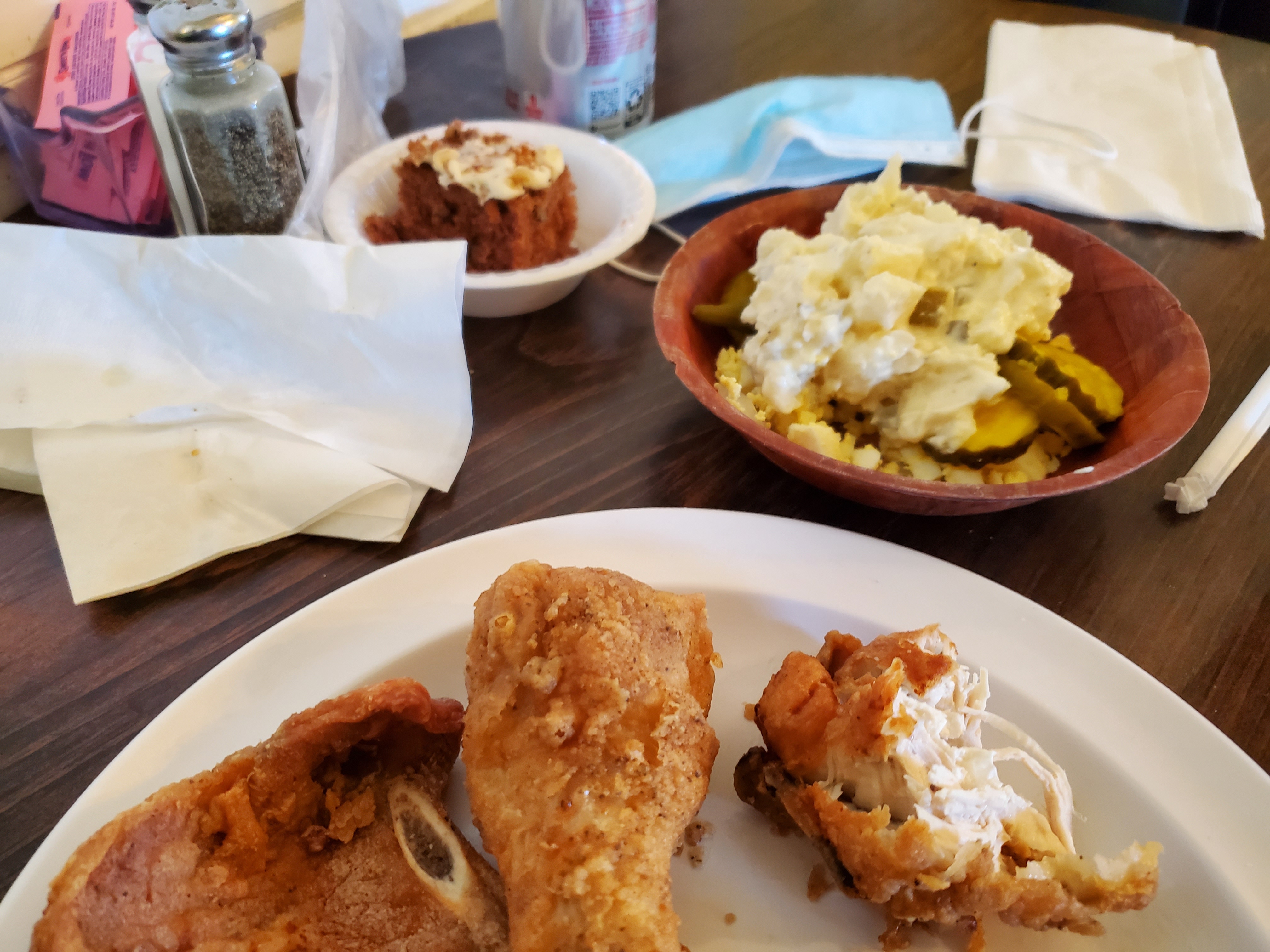
But, I will say the best fried chicken I’ve ever eaten was a few years ago at the Seaboard Station Restaurant in Hamlet, North Carolina. And they consistently have good fried chicken, and really tasty fried pork chops, cut thin. How do they get those steamed cabbage tasting so yummy without seasoning meat? Is that a little sugar?
 Bill Gibson, II