… and is Julia Louis Dreyfus related to Richard Dreyfus?
And the answer might be self evident, if I actually had known how to spell both names correctly:
Julia Louis-Dreyfus and Richard Dreyfuss, and “No, they are not related.”
So I’m puttering around this morning, fixing another breakfast of Fried Apples and Bacon, with some Hazelnut Coffee. I think I saw the name “Baton Rouge” on something, either on the TV or on a web page, and I said the name out loud, emphasizing the first part as “Bey Taun” and then “Rugge,” as in Luge. And that led me to recalling that Moulin Rouge meant “Red Windmill,” to which my processing went, then Baton Rouge must mean “red stick.”
I’m not sure if I’ve ever thought this through before, but laughing slightly to my first thought, that “Baton” sounds like “baton” which is a form of stick… or something that a cheerleader once twirled, throwing it up into the air and then catching it before it hit the ground. I then said to myself, “well stranger things have happened,” and “Baton Rouge” might just mean “red stick.” So, I googled for the answer and sure enough, “Baton Rouge” means “red stick” which according to the Web, a red pole (marker) delineated the border between two Indian hunting grounds (I may have remembered that correctly.), and a French explorer seeing this came up with the name “Baton Rouge.”
Sometimes things like this remind me of other like occurrences. Once, I was taking a “Biblical Hebrew” language course and the whole class was translating a long Bible passage. The woman instructor was walking around “looking over our shoulders” to see how we were doing. I had translated a good portion of the text but then had come to a problem. A certain word seemed to mean, “one who travels about the hills & valleys tending sheep,” but this didn’t seem to fit with the meaning of the rest of the passage. The teacher stopped me and then suggested I say the word audibly. “D-V-D”. It was then that she pointed out, this wasn’t a word, but actually the name for “David,” who by the way was a tender of his father’s sheep.
I have pointed out the many components of this one photo taken of me, by Mary Ann (age 22), in 1960. I’m not sure if she took this picture in February, or possibly in January either on my birthday, or a short time later. I was born on January 18, 1954 so I would have been six years old in this photo. I think this shirt and pair of pants looks really good on me, and I have a good haircut for the time.
*Over the 2024 Christmas holiday, I checked with Mary Ann, and she doesn’t recall if the photos were taken on my birthday, or a short time later. The “FEB 1960” tag on the edge of the photo was probably the date the photos were actually developed, not taken.
But now, lets take a look at the various components of this picture.
I am on the back porch of the old home place that was located on the corner of Highway 24 and Queens Creek Road. This house would be moved a short distance down Queens Creek Road and Uncle Bob (Robert Preston Morton, my mother’s brother.) and his family would live there for the rest of the life of the house. Without checking, I think Bob died in 1992, twelve years after my mom’s death in 1980.
The back porch is wooden, and look at the edges of the porch. They are razor straight, which means that this porch was relatively new. It had probably been replaced maybe only a year or so prior to this picture. A wooden porch, with age begins to deteriorate around the edges. The wood breaks off because maybe someone stands on the edge to jump off. I think it may be painted, or would be painted, probably a gray color. This would help the wood to last longer. Not the color of the paint, but the paint itself.
To my back would be a couple of doors that were access to/from the kitchen. There were no other doors to the kitchen, so you had to either come onto the porch from the yard, or you came onto the porch from the back door of the house. There was another door from the bathroom onto the back porch, but it was almost always closed and rarely used. Another thought with old houses is that they settle with age and the doors and windows don’t open or close without “sticking.”
There were two sets of steps for the back porch. One set was about mid length of the porch, about where the front bumper of the car is nearest the porch, and the other steps are at the end of the porch. As you walked off the back steps, there was a large Propane gas tank (a 100 gallons tank) just to the right sitting up off the ground on short cinder blocks, and on the other side of the gas tank was a flat topped water pump house. *The Propane gas was used for our kitchen stove. The cinderblocks were meant to keep the metal tank from touching the ground and becoming rusted. The tank was this shape, but the whole thing had been painted with a silver colored paint.
Notice the tangle of vines just in front of me and the bicycle. These were part of a Wisteria vine. It is highly intrusive, and will climb up a porch post, or up a light or power poll, or up a tree. It will kill a tree or will slip into the eaves of a house and cause a place for water or air to leak into the roof. The redeeming features of Wisteria are that they have a pretty purple flower, and it smells good when in bloom.
I’m sitting on my new bicycle that had been bought at the Western Auto Store in Swansboro. It was an AMF Roadmaster and was green and white in color. The chain is off the bike as a result of mom trying to take the rear seat off the bike. I thought the back shelf looked stupid and didn’t want it on the bike, but to remove it you had to unbolt some bolts and this changed the distance of the back wheel from the front and as a result the bicycle chain became loose and fell off the spokes. Someone besides my mom probably had to fix the bike. Neither she nor I had the mechanical acumen to correct this problem.
I think I see the edges of a couple of wooden chairs behind my rear bicycle tire, perhaps rocking chairs that might have been on the back porch.
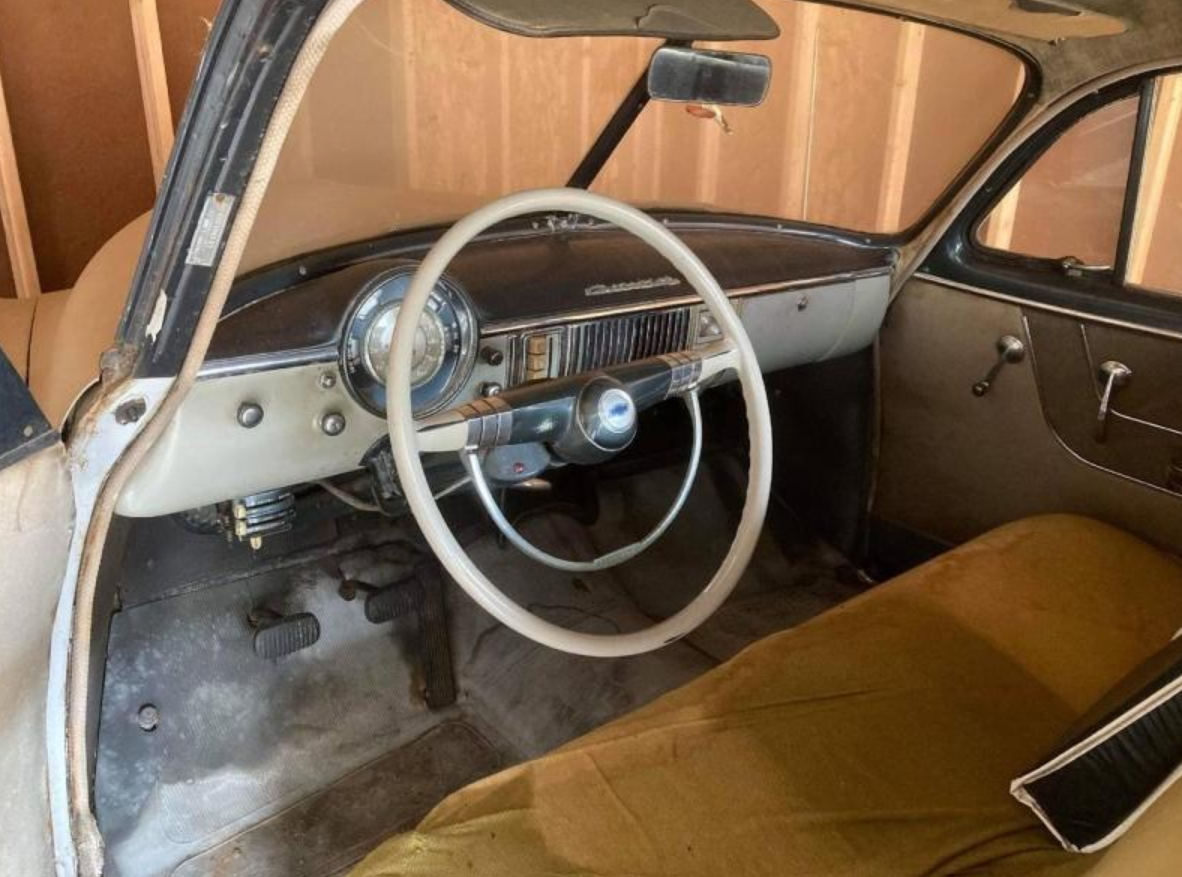
The car seems to be parked too close to the porch & porch steps. It was an old Chevy, a Chevy Styleline, beige in color, and maybe from the early 1950s because of the bumper grillwork. Nothing fancy. A neighbor, Mr. Gilbert Trot, owned a black Chevy like ours and drove it back and forth to the Marine Base where he worked for many years. We thought he must take really good care of car for it to last so long.
*Bob had an old Ford that was also a beige color, and was probably from about the same time period. I think his next car was a little white (or light colored) Ford Falcon. Our next car would be a brand new1964 1/2 Ford Mustang, Prairie Bronze in color, and a Fast Back 2+2.
After the Mustang, I would get the next new car, a 1971 Pontiac LeMans, blue with a white vinyl roof (the vinyl had a little knobby texture), for my Senior Year at Swansboro High School. Mom would take this new car the next year to drive to her work. This was my first year at Carolina (Chapel Hill) and Freshmen couldn’t have a car.
Off the back corner of the porch you see a little house, almost a shed, but it was an old lumber jack’s house that had been bought so Aunt Lyde (Lyde Glynnister Jones) could live separately from the rest of us. Lyde like several of the Morton brothers and sisters had Tuberculosis (TB). TB is a contagious disease.
The little house had enough room for a single bed, a shelf that ran the length of the building and on which to keep a hot plate to heat water, and not much else that I recall. There had to be room for a few clothes. I rarely went into this house, but I seem to recall being inside one sunny afternoon and windows rand along on wall from the front to the back and the shelf was just below the window. Maybe there was even a plant on the shelf, and a single burner hot plate.
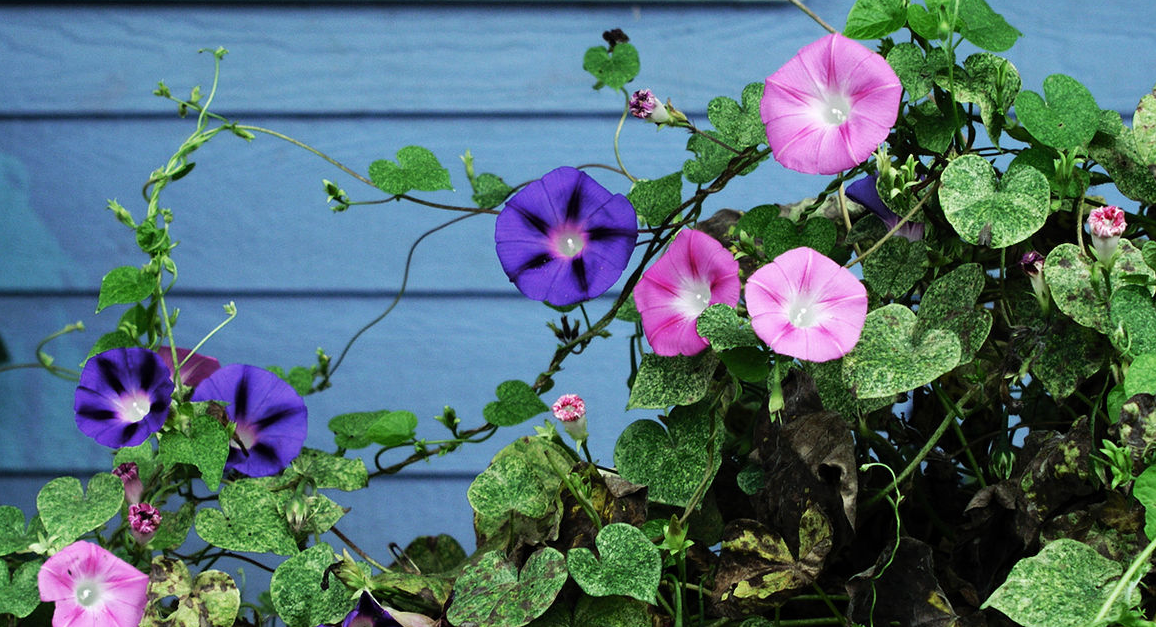
If you look just behind my head/neck, there is the old mule with his ass facing the camera. I don’t remember feeding him, or recall his name, (I’m sure he had one.) and I never played with him, and eventually he was sold, and I don’t know to whom. He is standing in a pasture, on the other side of the drainage ditch that ran along the back side of the kitchen. There was an electrical fence that ran around this pasture to keep him inside. *I remember early one sunny morning, that the dew was glistening on the colorful Morning Glories that were dangling down from the electric fence.
This was also the pasture in which the old “pack house” was located. To his left, just beyond his nose was the Queens Creek Road and in the distance above the mule’s head was the old tobacco barn, the one that burned down. It’s difficult to tell, but between the mule and the tobacco barn was Queens Creek Road (QCR).
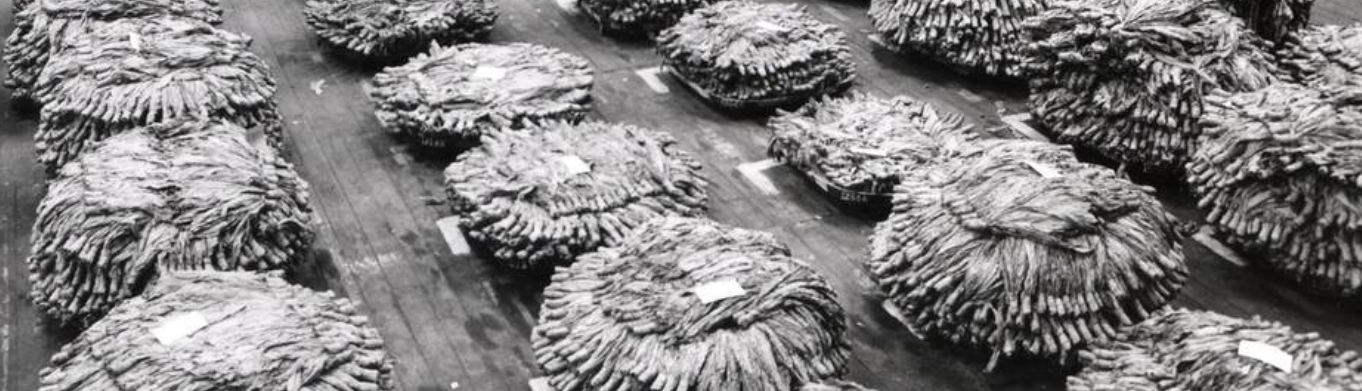
The main part of the farm was located across QCR from the old home place and the pack house. *The pack house was used to pack the cured tobacco into large burlap sacks (a large square of burlap that could be brought together by the corners and tied into a bale, of tobacco leaves). The cured leaves were placed with the stalk end of the leaf facing outward, and forming a large donut shaped stack of tobacco.
At Market where buyers could walk along and examine the quality of the tobacco.
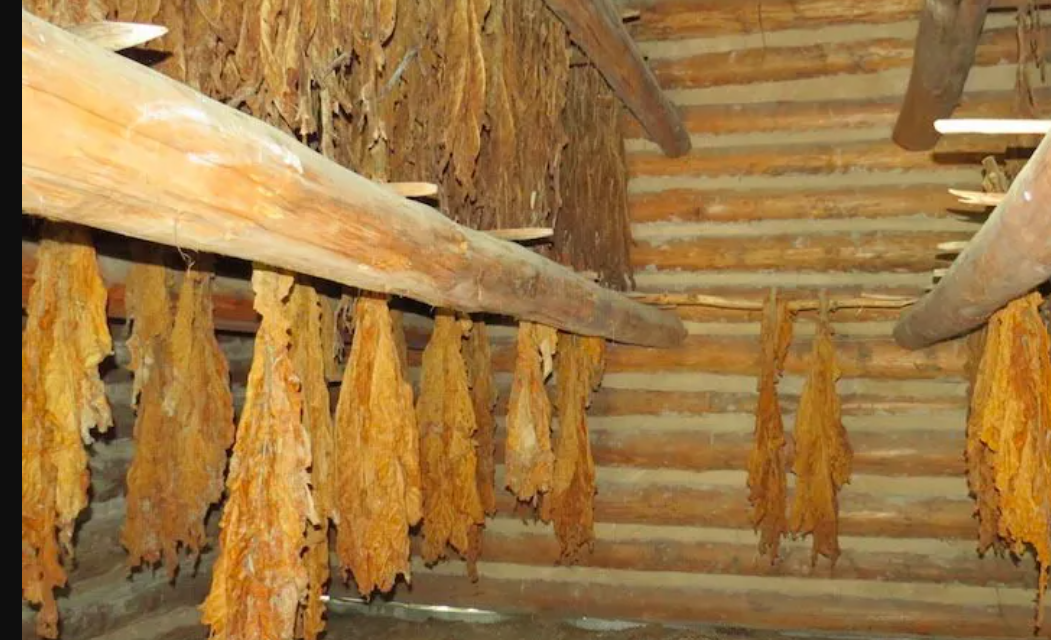
The uncured (green) tobacco leaves were first tied onto a long wooden pole with tobacco twine. Tobacco twine is thicker than thread. The twine needed to be thick enough to hold the tobacco on the stick while it was being cured in the tobacco barn, but weak enough to be easily broken by hand when you wanted to remove it from the tobacco stick.
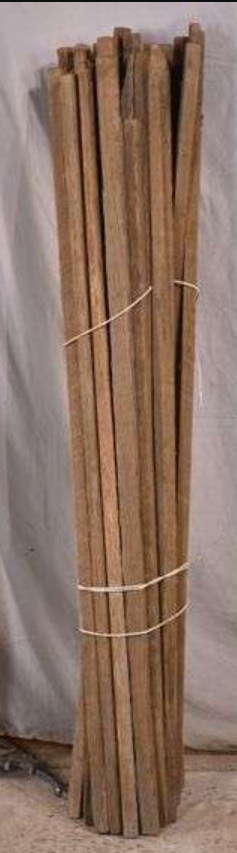
The green, uncured tobacco leaves were first tied to a long wooden stick, about three leaves together at a time, and the twine looped over the stick to hold the leaves on. When finished each stick probably held about 45 leaves hanging straight down in a line.
.
.
The sticks with the tobacco attached to them would then be put up in the rafters of the tobacco barn, which basically would become an oven, heated to draw the moisture out of the tobacco leaf, and turn it golden brown (thus the name Gold Leaf). You didn’t want so much heat as to burn the leaf, but just “cure” it. The rafters of the barn were far enough apart so that the long tobacco sticks would be held up, but hot air would be allowed to flow upward through all the leaves. I’m not sure if the heated air was recycled back down and then up again, over and over, but that would make sense.
What I have described above is “old school.” It is the way that tobacco was cured and then tied into bundles (burlap sacks) to be driven to market during the 1960s. I know there were markets in Greenville & Kinston.
Tobacco was “big business” during this time. In fact, I think few people thought that tobacco would every not be big business. The North Carolina Economy was dependent upon King Tobacco. But as with many things since that time, health concerns nation and world wide became more important and tobacco became much less important.
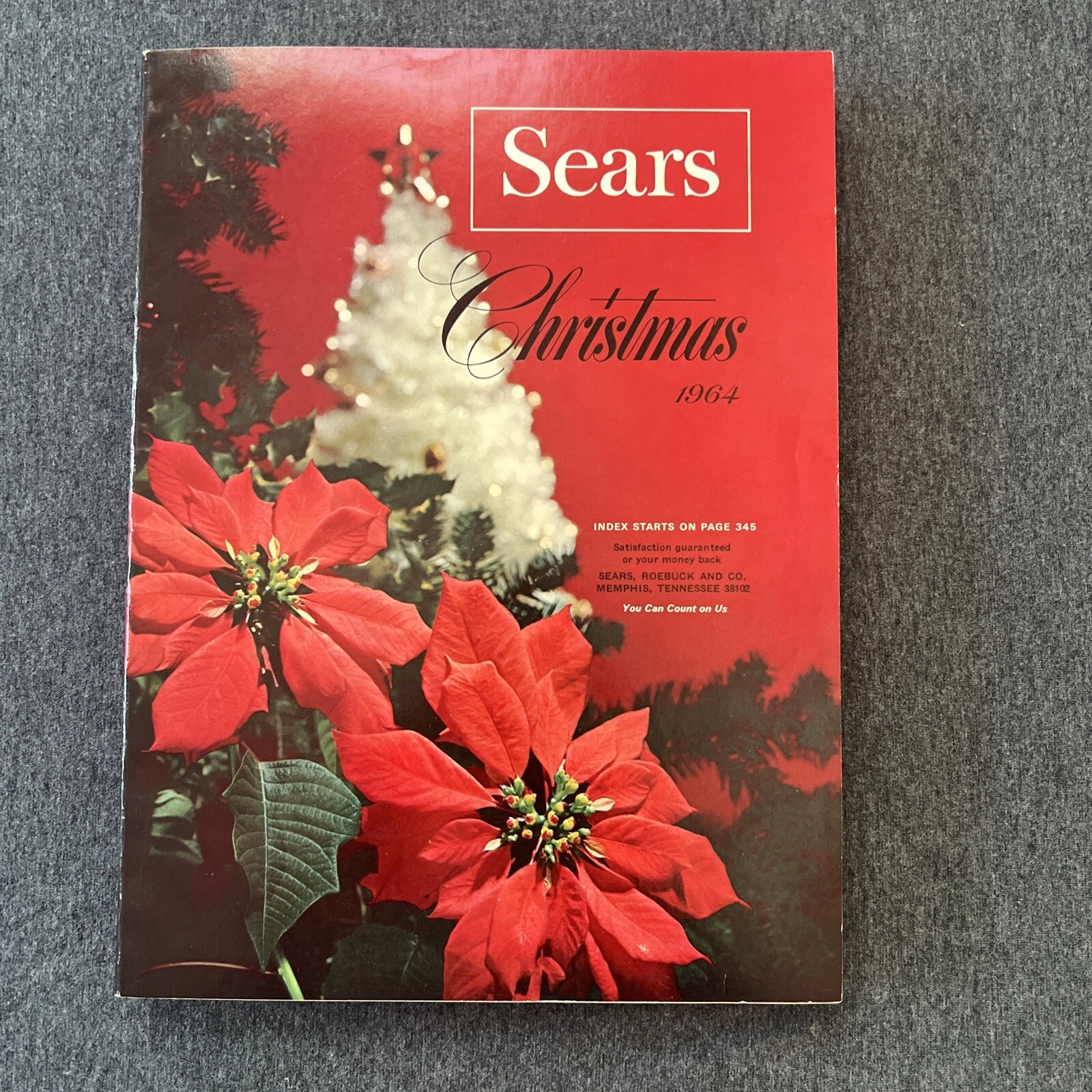
Another example would be Sears. Sears was the “only game in town.” We didn’t have the Internet, Amazon, or a local WalMart from which to buy all our needs. Sears didn’t sell groceries, but it did sell just about everything else. And we learned about what it had to offer by getting thick paper catalogs filled with pictures, product descriptions and prices, and an order form several times a year. There was a summer, winter & Christmas catalog filled with ideas for men’s, women’s, and children’s clothing, underwear & shoes. Toys & games for all ages, including adults. Household goods, like coffee pots, irons, and various electronics like radios & TVs. There was no Cable or Streaming TV, but the three basic networks, ABC, CBS & NBC were all being pushed out over the invisible “air waves” to provide entertainment and commercials to let us know what we should want. If you needed something immediately you might drive to Jacksonville to buy some items at Rose’s Department Store, or the local Sears. *How have Rose’s Department Stores continued to the edge of the new year, 2025?
A trip to New River Shopping Center in Jacksonville might be once a week, or every two weeks. There was a grocery in Swansboro, but Jacksonville had the Colonial Store. And one Saturday morning, Rick Tash, a TV personality from Wilmington. came up to the Jacksonville Colonial Store and made an appearance giving away balsa wood gliders to the children, of which I was one.
As promotional gimmicks, you could get the latest volume of the Golden Book Encyclopedia and eventually obtain the entire set of16 volumes from A thru Z. What colorful covers each volume had, with various symbols for that lettered volume.
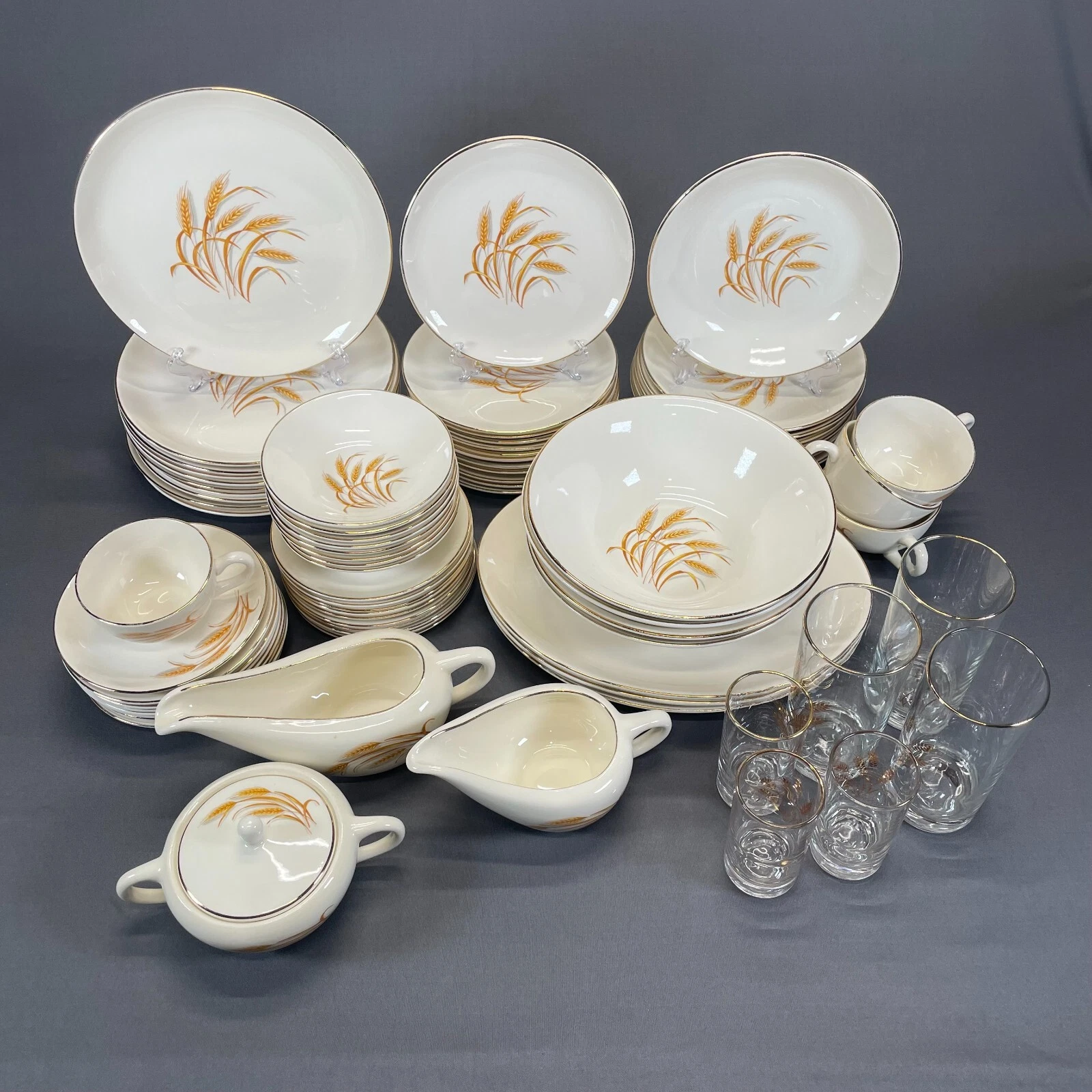
Another gimmick was a set of Golden Wheat dishes, but you could only buy one type of dish each week. It may have been more than each week, but you could buy the cups one week, and the saucers the next, and the salad plate, and next the dinner plate, and eventually when you had several place settings you could buy the special gravy or sugar bowl, or creamer or covered butter dish.
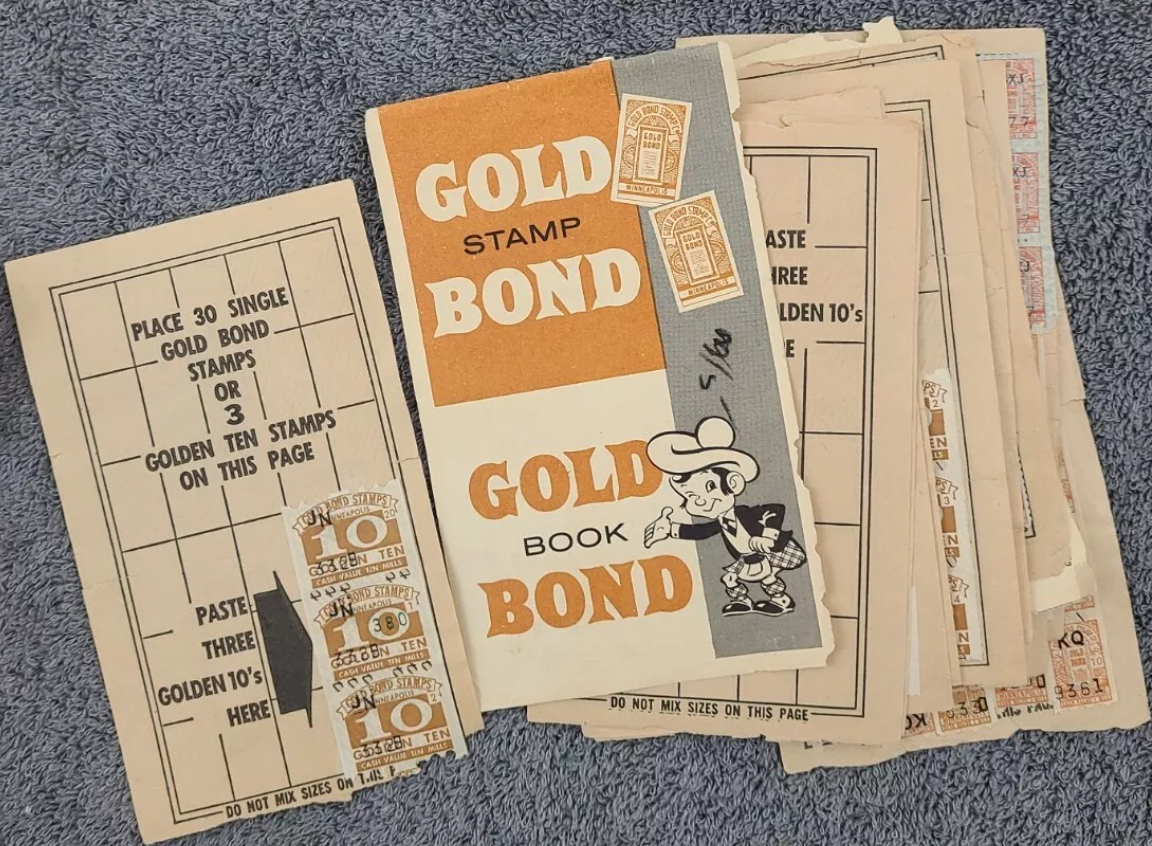
Finally, I should mention Gold Bond Stamps. These were like S&H Green Stamps. You received a certain number of Gold Bond Stamps for the amount of each grocery purchase. Spend more money, get more stamps. You pasted the stamps in a Savings Book. The idea was that when you collected a certain number of filled books, you could redeem them for various items. e.g. a portable radio, an iron, a game or toy, etc. You would take the filled savings books to a “redemption center” and get your preferred item.
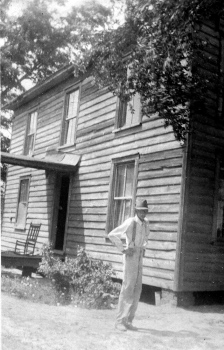
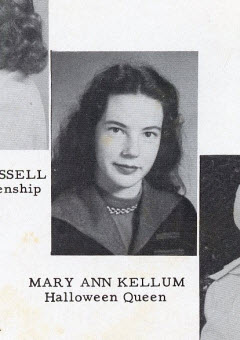
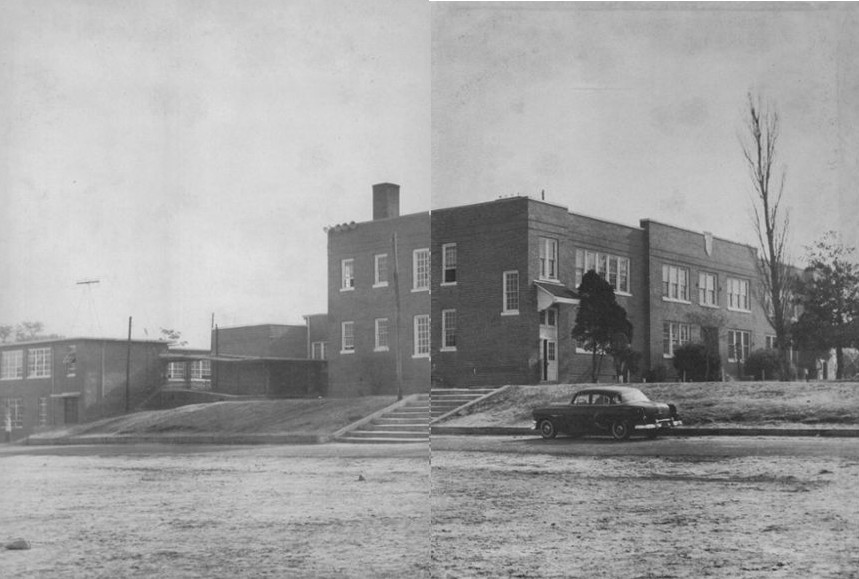
Papa at Back Corner of Old Home PlaceMary Ann in High School1st Grade1960s Swanboro Elementary Auditorium1960s Swansboro Elementary from Play Ground Area1960s Swansboro Elementary CafeteriaPapa, Onnie & Thalia Front Yard & Hwy. 24Looking Out Swansboro Burger King Drive Thru Window Toward Old FarmBurger King Swansboro Corner Hwy. 24 & Queens Creek Road
Notes on the above photos & images:
Lawrence deLafayette Morton (“Papa”) died in 1950 (see obit at bottom of page). In this photo he is standing at the back corner of the old house. He is looking toward the photographer, who is either standing beside Queens Creek Road or in it. The house still has wood siding, but by the time I can recall they had put light colored asbestos shingles on the outside of the house & a smooth sheeted asbestos shingle skirting (to keep the cold air from blowing beneath the house. I see a rocking chair sitting on the back porch just outside of the back door. *But, there is no wall for the bathroom, so it had not been built yet. Mary Ann told me that there were steps here to make it easier to go to the Smoke House and she thinks the bathroom was added in the 1940s. You can see the branches & leaves of some of the tall oak trees which grew near the front of the house.
The picture of Papa, Yvonne “Onnie,” and Thalia show them standing in the front yard of the old house when it was still on the corner of Hwy. 24 and Queens Creek Road. Years later, the Swansboro High School (from which I graduated in 1972, not the current new one) would be built on the other side of Hwy. 24. They would be where the current Swansboro Burger KIng is located. Note the large oak trees.
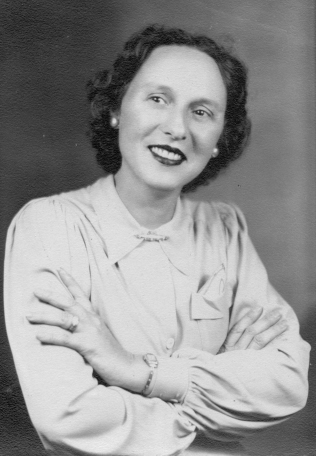
Mary Ann Kellum (Sharpe) is pictured here still in high school and she might be near the age of 16 which I was born on her 16th birthday, January 18, 1954. She took the photos of me on the back porch with my bicycle and in the living room next to our TV in 1960.
This is my 1st Grade photo. I don’t recall if this is 1960 or 1961, but because of my birthday, I was one of the oldest students in my class. There were just a few others older than myself.
I attended Swansboro Elementary School from 1st through 5th grades and I have several photos of a May Day celebration when this facility was still the Swansboro High School c1952. Mary Ann participated in the May Day but is not recognizable in any of the photos. Several years ago some of the buildings in this facility (the cafeteria & auditorium sections) were demolished as were the 1st & 2nd grade buildings. But the remaining two story structure is still there and is now part of a nice apartment complex (See below on Google Street View.)
I was either in 4th or 5th Grade in 1963 when President John F. Kennedy was assassinated. I recall that my classroom was upstairs in the back of the existing building. An aid or another teacher came into our classroom and whispered something to our teacher. She was telling her that President Kennedy had been shot. I think the President’s funeral procession was televised on Saturday morning, and I remember wishing they hadn’t taken off my favorite cartoons to show his funeral.
My story on the Auditorium is that one year our class was putting on a presentation for all the grades in the auditorium. One group of boys was singing “King of the Road,” which was a popular song, and I wanted to be in that group, but wasn’t. I was part of a group that was singing & dancing to “I’m Telling You Now,” by Freddie and the Dreamers. We were dancing, “The Freddy,” which required you to flap you arms and legs alternately to each side of your body. I’ve seen video of this from the original group on YouTube. On the day that we performed our song & dance (two performances, one for the younger grades & one for the older) our group was standing on the stage side by side. We started singing & dancing and part way through the presentation I looked down on the front row of the audience and saw some people staring, poking each other and laughing. I looked down and my “fly” was open. I don’t recall if I turned around and continued to dance, or not, but we finally finished the song to my relief.
I recall working as a student helper in the Cafeteria. There was a little window where students brought all their dirty dishes & used milk cartons on their trays and placed them on the window’s shelf. The trays would then be taken and the paper products thrown into the large gray rubber trash can. The remaining food would be scraped off from the dishes into a “slop” container and the dirty dishes, silverware and trays would be put where they would be conveyed into a steam cleaner, to be cleaned for reuse the next meal. After doing this several times, I decided that I didn’t want to do it any more, and didn’t.
One day we had sauerkraut as part of our meal. We probably also had those thick red sausages that were slightly curled from cooking. I don’t recall what other sides went with this lunch, but I do know we had a half pint of milk (Maola). as always. On this day I didn’t want to eat the sauerkraut, and I noticed other “boys” instead of eating their sauerkraut, they were stuffing the sauerkraut in their milk cartons. I normally would not do something like this, but I really didn’t want to eat the sauerkraut. But, I also still had a half full carton of milk, but I put my sauerkraut in the half filled milk carton anyway. I then got up and headed with my tray and dishes to the window. But just before I got there there were a couple of teachers standing talking. One teacher stopped me and lifted my milk carton and then told me, “You haven’t finished your milk. Go back and finish it.” I didn’t realize it then, but thinking back on the situation, I wouldn’t be surprised if she hadn’t seen me stuffing my sauerkraut into my milk carton, and was giving me my ‘just desserts.'” I went back and tried to drink the milk/sauerkraut mixture but let me say the two do not combine into a drinkable drink. I gaged, and didn’t drink any more, and fortunately the teacher either was gone or didn’t stop me on the way to put up my tray.
The result of this event was that I didn’t eat sauerkraut for a long, long time afterwards. It may have even been 30 or 40 years later before I put some sauerkraut on a Pastrami & Rye Reuben sandwich and enjoyed it. I have since found that mixing a little Thousand Island dressing along with the sauerkraut makes a delicious side dish, after all you mix the two to go on the Reuben sandwich and that tastes good.
On the first day that the Swansboro Burger King opened, a Sunday, I went down and sat in a booth by the Drive-Thru and looked out trying to imagine where the old kitchen & smoke house had been located. The view in this picture looks out across Queens Creek Road and on to the old farm, which now has the new Queens Creek Elementary School. The new Swansboro High School is next to this elementary school, and the Morton Family Cemetery (my mother, her parents & a brother and sister are buried there) are located here.
Lawrence DeLafayette Morton Obituary (Daily News 1950)
Onslow County NcArchives Obituaries.....Morton, Lawrence DeLafayette June 22, 1950 ************************************************ Copyright. All rights reserved. http://www.usgwarchives.net/copyright.htm http://www.usgwarchives.net/nc/ncfiles.htm ************************************************
File contributed for use in USGenWeb Archives by: Bill Gibson bgibson@uncfsu.edu March 25, 2006, 8:28 pm
Jacksonville Daily News Jacksonville Daily News “The World That Gives A Whoop About Onslow County” - Tuesday, June 27, 1950
LAWRENCE D. MORTON
Lawrence D. Morton, 78, died at his home near Swansboro Thursday morning. Funeral services were held Friday at 3 o’clock at the graveside conducted by Rev. R. L. Wethington, pastor of the Swansboro Methodist Church. In addition to his wife, he is survived by five daughters, Mrs. Lyde Jones, Charlottesville, Va., Mrs. Earle Hughes, Portsmouth, Va., Mrs. Zeta Littleton, Portsmouth, Mrs. Raymond Kellum, Hubert, and Miss Vivian Morton, Hubert; and two sons, Edgar and Robert, both of Hubert
Additional Comments: This is Lawrence deLafayette Morton, son of Westley Edward Morton and Marinda Caroline Thomas. His wife was Thalia Alma Freshwater. He was buried in the family cemetery which is now located in front of the Queens Creek Middle School, just outside of Swansboro, NC.















 Bill Gibson, II