
I grew up living on the corner of Queens Creek Road and Highway 24 until I was in about 8th Grade, and then my mother and I moved to Hubert to live with her sister, Carrie Kellum. We all called her “Sis.”

The house was covered in white asbestos (cancer causing) shingles that had a ribbed surface. It was a two story farm house with wooden first and second floor porches that ran almost the length of the house in the front. The porches didn’t quite make it to each corner of the house, maybe by 3 or 4 feet on each side. The top porch slanted toward the ground so we rarely walked on it, but there was a door both on the first and second floors, and just inside of each was a small hallway. *I do recall going out on the top porch once and walking to the end where our TV antenna was located. I used the aluminum TV antenna pole to slide down like a fireman.
The front porch steps were not wooden, but I don’t recall, I think they were a rough sandy poured concrete with bricks on both sides, and only two or three risers. There were several tall oak trees at the front corners of the house and along Highway 24. One oak was rotten at it’s core. The front yard was very sandy.
I’m not sure if I really miss it, but I liked the sound of rain on the tin roof, and when the branches of the nearest oak trees swayed you could hear them screeching on the roof.

I said the only way to get from the front of the house to the kitchen was through the hallway and out the back door, but a more circuitous route would be to walk around the house, on either side. Neither of these ways were prudent, if it was cold, or raining or stormy in any way. In reality you couldn’t get into the kitchen without going outside on the back/kitchen porch. The side of the house nearest Queens Creek Road had the TV antenna, on an aluminum pole, at the front right corner of the house (facing out), and then a brick chimney, and then a large Kerosene oil drum which was sitting off the ground on two large concrete supports. The supports must have been connected in some way, but I don’t recall how, and the oil “drum” was wide and tubular, and depending upon how much oil (kerosene) was in the drum, you could get different sounds by thumping one end of the drum. It seems that both the kerosene oil drum, and the Propane gas tank at the end of the kitchen were both painted with an aluminum colored paint. This color probably reflected light & therefore heat better than other colors.

Above, black & white photo. Note the Wisteria vines growing beside the back porch. I think the term might be “they are and invasive plant.” We had a Wisteria vine growing in the front yard at 204 Johnson Boulevard in Jacksonville, NC for many years. The CP&L guys would come by annually and trim back the vines which were growing up the nearby power pole. But, each year they would grow back. One year CP&L got serious, or it may have been me, and the Wisteria was cut back to ground level and root poison sprayed on the nubs. It didn’t grow back for several years, and then it started growing again and eventually made its way along the power line and into a tree. And after a while it began to kill the tree.
Other invasive plants & trees that had become a part of our culture included Kudzu, and Mimosa trees. I loved how the Mimosa’s flowered during the summer. It was only years later, as a young man I began to read about these flora and that they weren’t originally native to North Carolina.
.
.
The house was only one room deep, except for the bathroom, which was behind the main bedroom, and the kitchen was at the back. When I lived in the house, the only way to get from the front of the house to the kitchen was to walk out the back door onto the wooden back porch and then go into the kitchen. I think there were three doors off the back porch. One door was just outside the back door, to the right. This door was rarely opened, but went into the bathroom. I do remember opening it once, and it being “stuck” and difficult to open because of being closed most of the time. Seems like there were two doors almost side by side into the kitchen, and both basically in the middle of the kitchen. There were steps off the porch, one pair of steps were near the kitchen doors, and one pair of steps were at the end of the house.
I just had an image of some areas of the yard, butted up against the eves of the house. I said there was sandy soil in the front yard, and some right up next to the house, where much grass didn’t grow. This was a larger “river” sand and not beach sand. Beach sand has a fine grain, and appears as a beige color in the sunlight. But this river sand had mixed colors, with some clear, some off white, some gray and some black grains. My reminder was what happened when it rained and the water ran off the roof and fell to the ground just a few inches from the side of the house. You would get small ruts of bare river sand in which water would “pond” for a while during and after a rain.
When I talk about “the back of the house,” I have a conflict in perception of where this was actually located. Many people might view the back of a house as being the opposite side from the front of the house. That’s true, except in our case, we had a building, the smokehouse, which I considered as behind the house. In reality it was beside the house, and in the back. *Note that I said “we,” and as a child growing up in this house, the house wasn’t owned by me, it was my mother’s house.
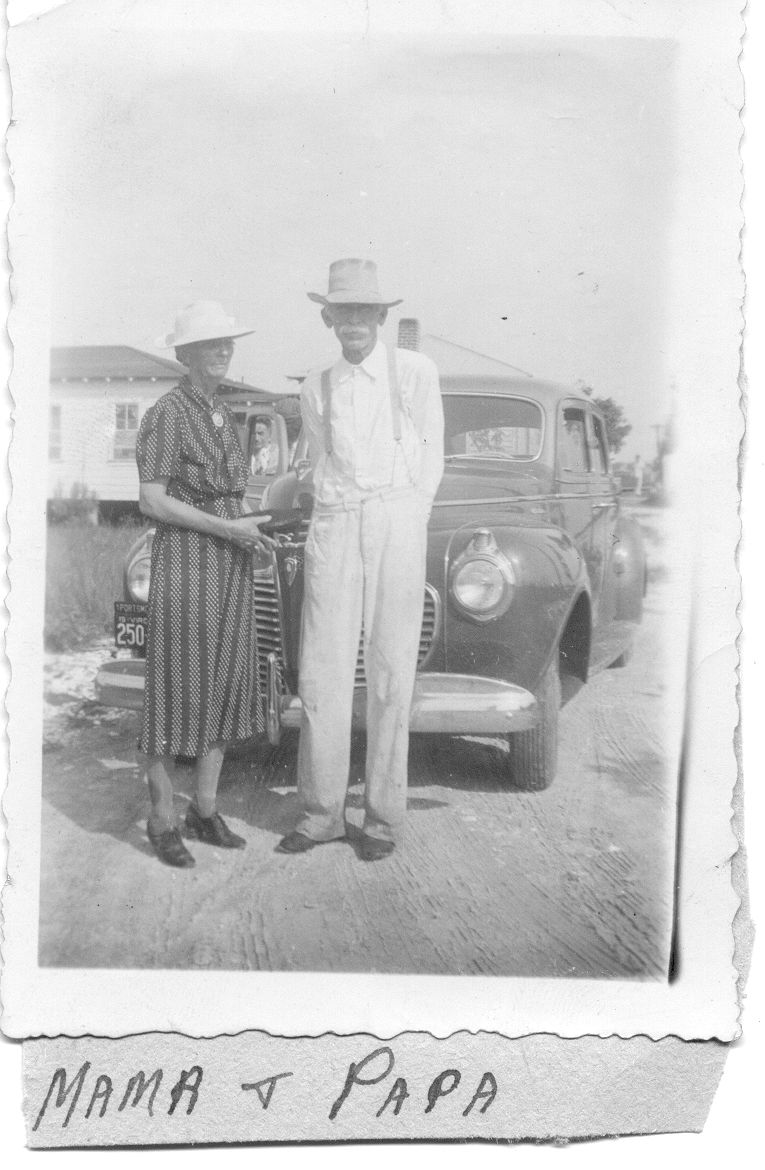
Her parents, her surviving mother (Lawrence “Papa” Morton had died in 1953.) had agreed that if she stayed and took care of them in their old age, she would inherit the old home place and the farm when they died. This didn’t sit well with her surviving siblings and it was contested. **I think one story goes that there was no will. It’s vague in my mind whether a will was “found” and a neighbor attested to it being valid, but that apparently is how the legal system came in agreement that the house & farm were solely my mother’s. I think Thalia (my mother’s mother) died in 1963. She had suffered from cancer, and I recall seeing the right side of her face (most of her jowl) completely covered by a cancerous scab. For a while her “sick bed” was in a corner of the living room.

I must have “had a mouth on me” even as a young boy (5 years old or so) and one time Thalia chased me off the back porch with a broom. I was standing out in the yard looking at her and she was demanding that I come back onto the porch. I might have been young, and with a “smart mouth,” but I wasn’t stupid. I didn’t come back on the porch while she was standing there holding a broom. *”Having a mouth on you,” means being sassy or “smart mouthed,” making snide comments about someone or something. Boy, that’s me all my life and even or more so to this day.
Lawrence & Thalia are buried side by side in the Morton Family Cemetery, right next to the Queens Creek Middle School. In fact, school buses dropping off and picking up children, drive between the school and the small cemetery. Four of their children are also buried in this cemetery: “Buddy,” “Lyde Glynnister Jones,” “Robert Preston ‘Bob’ Morton,” and my mom, “Vivian Inez “Mick/ey” Gibson.”
**At the moment I don’t recall what “Buddy’s” real name was. Perhaps “Lawrence” after his dad. At one time, he was a “Merchant Marine,” and I have a picture of him hanging off one of the ships he was working on. The picture was on one of the pages of the old Morton Family Album. Those pages were a beige color and had around the corners of the pages become brittle with age.
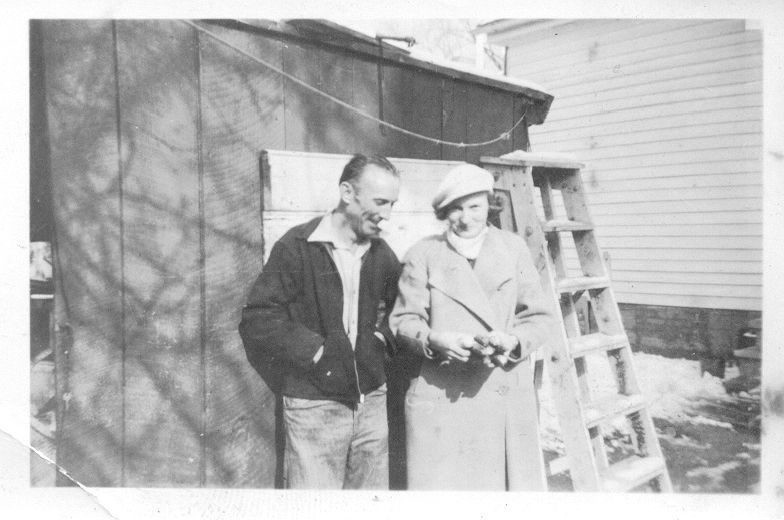
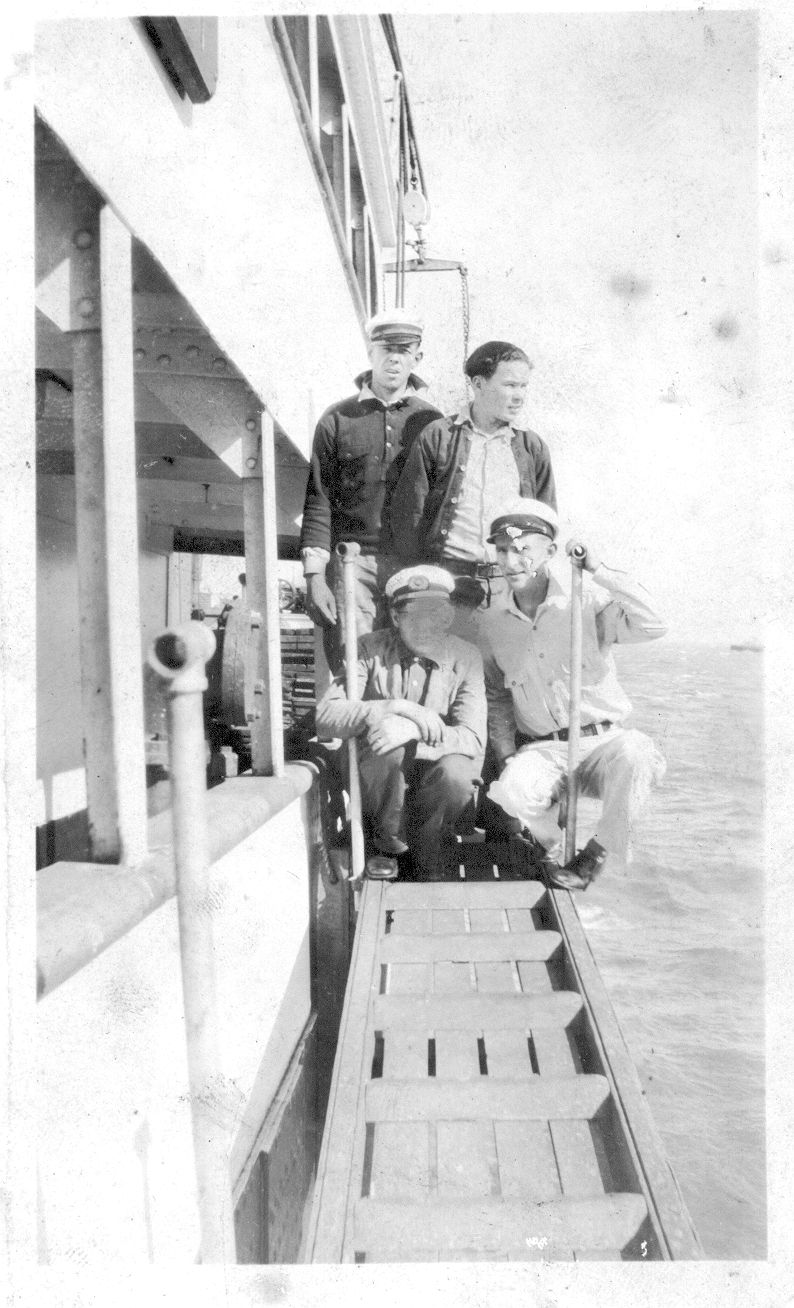
a gangplank.

***The brief story of Buddy was that he could be mean, shooting small animals and birds with pleasure and once nicking a power line the bird was sitting on. He did work as a sailor on merchant ships during WWII. He was sickly. He had tuberculosis, which he succumbed to on the back porch, apparently coughing up some of his lungs and blood and dying. Mom had to get towels to try and clean up that mess off the back porch. A neighbor, who had a station wagon, put Buddy’s lifeless body in the back of her vehicle and drove him up to Jacksonville, NC for an autopsy. On the way, the neighbor stopped by Sis’s house in Hubert on Highway 24, to let Carrie see his body. Whether it is true or not, a story said that his feet were hanging out of the back of the station wagon.
So walking around the house from the front, and nearest QCR (Queens Creek Road), you would turn the back corner of the living room with the kerosene drum just to your right. Sometimes the old Army gray Chevy would be parked at an angle, facing the kitchen porch steps. I don’t recall backing (I wasn’t driving.) the car out, so it must have been driven completely around the house to complete a circuit. The back yard wasn’t used as much as the side nearest Queens Creek Road, and there was more grass on the back side. The old “smoke house” was on the opposite side of the house, and a short distance away, toward Hwy. 24 was the old wooden garage. The garage had large wooden, doors that weren’t even and were slightly “flimsy” as they were opened or closed on their hinges. The outside of the garage might have been covered with the same sandy colored and grained asphalt shingles. I don’t think it was just unpainted wood. *At the back end of the garage, nearest a triangular shaped garden area was a double seater concrete toilet. But, by the time I came along this was no longer covered, or used (thank God). It just sat butted up against the back of the garage unused and too big and heavy to move, and covered by grass and weeds. There may have even been some briar berries (Blackberries) that grew around the grass covered concrete, and maybe a few spiders and even a snake or two.
The garden area was large. At the front, it ran along Hwy. 24. If you stood at the back corner of the garage nearest the highway, you could walk a straight line back behind the garage, and then the smokehouse, and finally another 5 yards to the ditch. Just behind the smokehouse, the drainage ditch angled back toward Hwy. 24 getting narrower as you approached the highway and coming to a point. There may have been a drain pipe at that end of the garden that went under Hwy. 24. I believe it was the Heath’s who lived in the house at the end of the garden and along Hwy. 24. It may have been Mrs. Heath that allowed us to get some cuttings of her Gardenia bush. The root system was so gnarled that you couldn’t get a good root, but using a shovel we (my mom and me) cut several
I do recall the ditch was not as deep along the garden as it was directly behind our kitchen. Behind the kitchen you could probably stand in the ditch and your head might not be seen above the ditch bank. *As I describe the house and surrounding areas I am recalling words and phrases that I have not thought about in many years. “Ditch bank” was one of those descriptive terms, as is “smoke house” and “oil drum.”
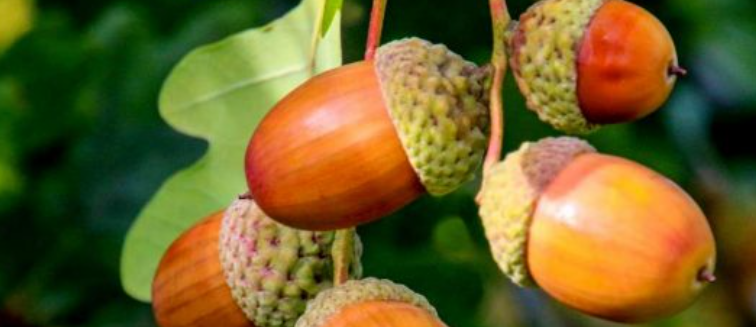
I don’t want to fail to mention “acorns” or describe them, their color and textures, the smooth dark brown bulb coming to a point, and the lighter beige color nearest the “cap” end. The cap of an acorn looks like a little hat, and it can be popped off. I’ve not “played” with acorns for many years, but in beginning to describe them here, I have such a vivid appreciation for how wonderfully made they are.
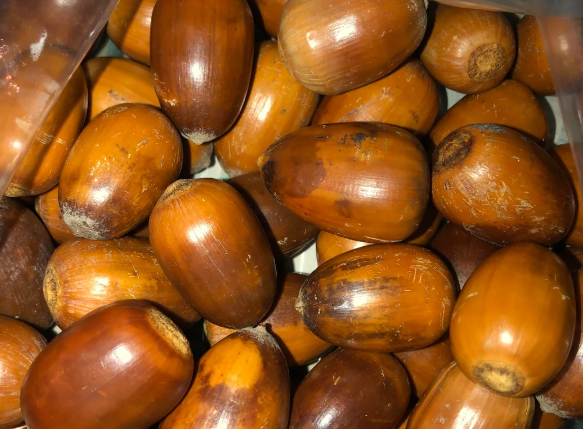
Acorns would have been one of my “play toys” as a boy. They would fall from the oak trees and lay upon the ground on the sandy soil and amongst the large roots of trees. You could hear them crunch as you drove or walked over them, if you had shoes on. But if you were barefoot, as I often was during the summer, stepping on an acorn would be mildly painful and they were to be avoided if barefoot.
Weeds I Have Known
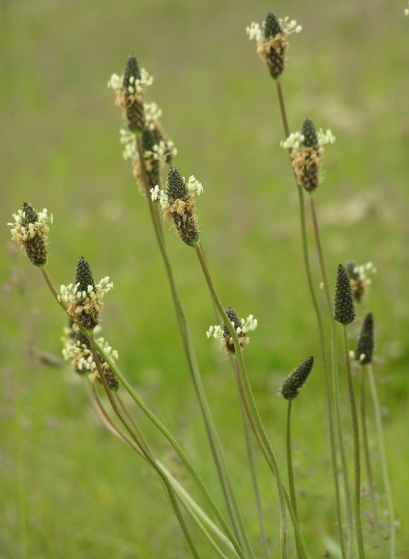

There was also a weed (Buckhorn Plantain) that had a long green stem and at the top end had a long brushy seed pod (seedhead) that was green but would turn brownish as it dried out. I’ve never thought of that end as being “a seed pod,” but that was probably what it was. I had a game I would play with these little weed stalks. I would break several of them off from their roots. I then would take one stalk in each hand and slap the stalks together violently, like two swords being thrust against one another in battle.
What would happen? Well, either the green stalk would break, or the seed pod would be snapped off the end. The goal was to have a winner. One see pod would snap off, and that would be that opponent losing “his head.” The winner would go up against a new opponent and might actually have an advantage over the next, untried opponent. A simple, stupid child’s game created with the tools at my disposal. But, it was a very human game that had two opponents, in a fight, fighting against multiple opponents and eventually their only being one winner. How do you get from weeds in the yard to ACC or NFL championships, or boxing matches? *I played with these weeds sixty years ago, but never knew until today what they were called. I don’t even think I had a name for them when I played with them.
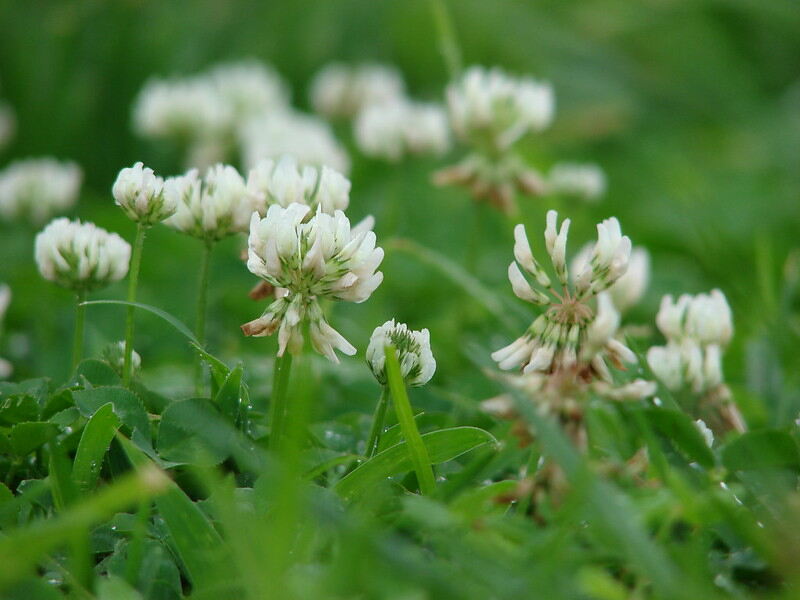
This was “White Clover” which grew in places in the yard. When it flowered as shown in the summer, you would need to watch out for honey bees who quietly darted from one flower to another. You didn’t want to step on a bee with your bare foot.
.
.
I don’t even need to know what this weed is called or if it is exactly what I recall, but there was a weed like this and you could grab it at the bottom of the stalk and strip the green leaves off of the stalk. There was no reason to do this, but it left you with a “green smell” on your hand. I think I did this when I was pulling up these weeds. You would hope to get the root with the stalk so that it wouldn’t grow back.
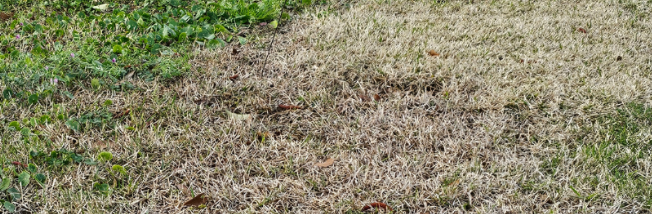
This might be typical of “yardgrass” in eastern North Carolina during the late summer when it began to die.
Plants I Have Loved

Some Morning Glories were growing along the fence line (Queens Creek Road) near the “Pack House,” with little beads of dew glistening in the morning sun. In the pack house attic, with the barn door open, the tiny particles of tobacco & dust were floating in the air, highlighted by the morning sun.
Gardenias. I’ve always loved the smell of Gardenias. We had a gardenia bush growing on one side of the front porch steps. Years later we would get cuttings of Mrs. Heath’s Gardenia bush. The Gardenia bush roots are so gnarly and intertwined that it was almost impossible to pull them up by the roots. We used a shovel to cut some branches off near the base of the bush and then planted them in mud (either in a pot or maybe a glass).
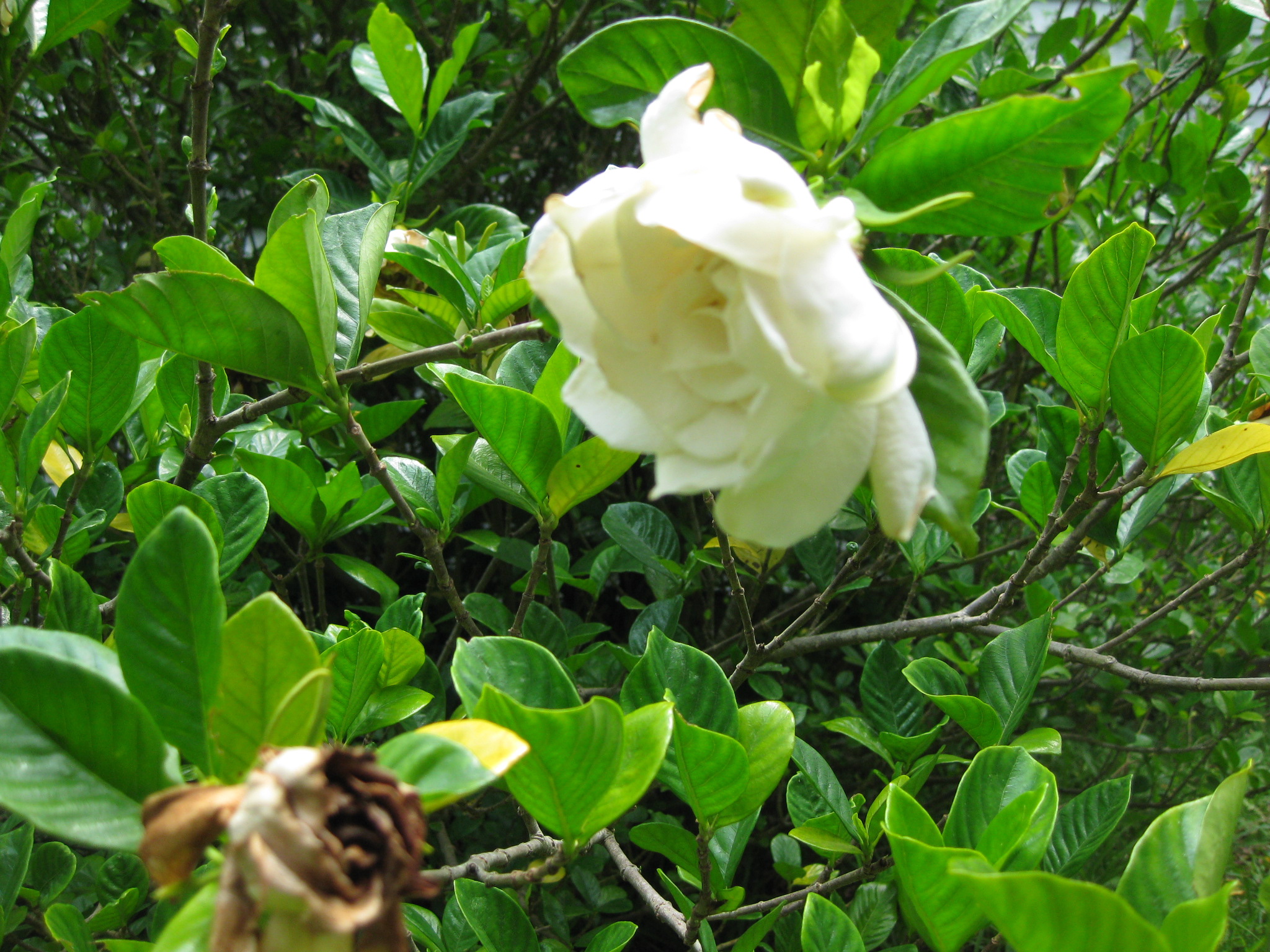
Surprisingly, to me, the Gardenia cuttings began to grow roots, and eventually we replanted one of these in the yard at 204 Johnson Blvd. in Jacksonville, NC. This gardenia bush grew well for many years, and even after the house was demolished, the gardenia continued to grow and flower in early June (I think it is early June, but only for a few weeks.). *Years later, I found that the Gardenia flower was pleasantly edible. It didn’t have any bitter flavor, and in the short season that it blooms it would work well in perhaps a fruit salad or dessert. On the fly, maybe you could add the white Gardenia petals to blueberries, and maybe even strawberries, and put it on top of shortcake, making a “red, white, and blue” dessert.

204 Johnson Blvd. in Jacksonville, NC as it was being demolished. Ray Sharpe & his wife, Jacquelin, owned the house at the time.
.
.
Yellow Daffodils in Spring. I love the smell of daffodils.
I’ve described the smoke house elsewhere, but it was shaped like an old “out house” (toilet building) taller than it was wide, but perfectly square around it’s base. It had one door skewed to the left side of the front of the smoke house and on the left, outside wall was a large black iron cauldron. Never used, for a “hog killing” as long as I could remember, but probably had been used well in years past. I’m thinking that it might have been used in some of the last years before Lawrence “Papa” Morton died. He died in 1953, a year before I was born. The outside of the smokehouse was covered with the sandy colored and textured asphalt shingles. But inside, was wood.
The smoke house was probably built of white pine wood, but because of all the meat that had been cured over the years, the wood had taken on a dark molasses color and the inside of the smokehouse had a smokey aroma. And the floor was made of a layer of salt covering a dirt floor. The salt probably came from the smoked hams.
To the right of the back steps was a 100 gallon Propane gas tank and next to it was the water “pump” house. Between the tank and the water pump was a little cubby hole about two feet wide. I got into trouble for hiding in this cubby hole to light paper airplanes I had made. I think my mother basically said, “You’re going to blow us all up.” It really didn’t dawn on me that I was lighting a flame right next to a Propane gas tank.
This reminds me of something else that I failed to understand for many years. When I was finished taking a shower (we only had the one bathroom) I would step out and leave the shower curtain folded. My mother would tell me to spread the curtain out. I just never would, I guess out of habit, until one day she said, “Spread the curtain out so it doesn’t mold and mildew.” When she added that little addendum, that explained why I should spread the shower curtain out, I never left the curtain folded again.

The layout of the bathroom: The shower/tub ran next to the kitchen wall from the back porch. Next to the shower was a wooden closet for towels, toilet paper, etc. On the inside of the unpainted wooden closet door I once drew the name of “Zoro” in red fingernail polish. Mom said I got in trouble for misspelling the hero’s name, “Zoro” instead of “Zorro.” Yeah right;-) Next to the closet was the commode. There was not direct access from the bathroom to the kitchen, but this was changed sometime after Uncle Bob and his family moved into the house. The house was moved a short distance down Queens Creek Road from the corner when Highway 24 was widened. I think that was the early 1970s. I don’t recall where the commode went, but they moved the toilet and made a entry way between the kitchen and the bathroom. The bathroom had a third door that connected it to the master bedroom.
As you walked in the front door, the wooden stairway was just off to the right, and the hallway went straight back to the back door which led out onto the back porch. About midway down the hallway was a door to the left which went into the living room. If you walked to the back door and turned right that door led into the master bedroom. Just to the right of that door was the closet door. The closet was beneath the stairway.
I once left a pair of red rubber boots in a plastic bag in this closet. The problem was that I had left some wet dough in a boot, and with the heat and humidity, maggots had multiplied during the summer, and the smell was awful when I finally found them. I think we just threw those boots out. The dough? I think I had been trying to make the kind of dough that is used for “Paper Machete” but it hadn’t worked.
The living room didn’t seem small when I was living there, but many years later, probably after Bob had died and only Flossie, his widow, was living there, I visited her. I rarely visited her. But, I recall how small the living room seemed then. She had also had someone, probably her son Evy (not Bob’s son, but from her first marriage) close off the upstairs porch with plywood. This also made the hallway seem much more claustrophobic.
Flossie collected dolls, and she had a bunch of dolls in a glass & wood cabinet.

When I lived there, you entered the living room from the hallway. Directly ahead of you, but across the room was the fireplace, but there was no fireplace. I think the fireplace had been enclosed and only the flue ran to the chimney. On each side of the heater was a window which faced toward Queens Creek Road, and there was a service station on the opposite side of Queens Creek Road.
This was before convenience stores, but there were a couple of gas pumps, and a cinder block building that had been painted white, with large glass windows on one corner and in the front facing Hwy. 24. There may have been a garage, but I don’t really recall if it was or not.
They did sell bread, crackers and candy and soft drinks.
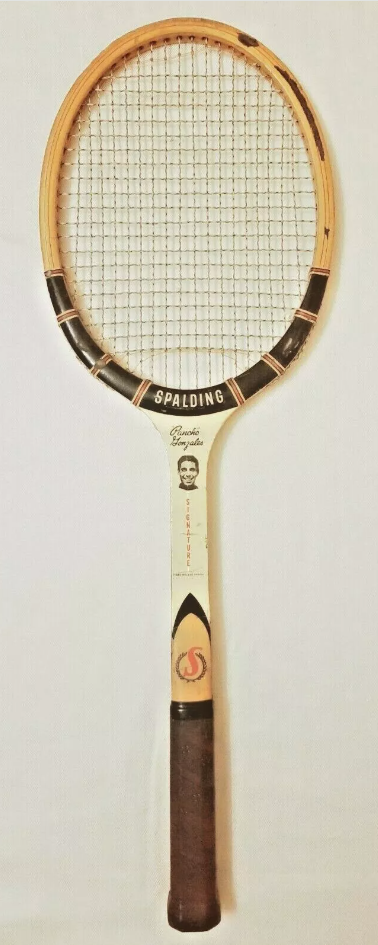
I do remember getting a tennis racket and because there were no tennis courts anywhere nearby, I walked across the street and tried to hit the tennis balls against the cinderblock wall of the gas station. The side of the building was paved, but the pavement was rough, and it didn’t take me long before I had lost all three tennis balls on the top of the building. I had no way to go up and get them, so that ended my tennis career until many years later. I took up tennis again when I transferred from UNC-Chapel Hill to Campbell College (it was still a college then, in 1975).
I had a wooden Poncho Gonzales tennis racket that I rarely used when I got serious about playing tennis, and this may have been the racket I used against the store wall. Once serious, my rackets would be either metal or ceramic or composite. A “Red” Head and … I painted the wood racket a bright blue, which made it heavier. I also once strung this racket with fishing line. Fishing line is not made to be strung as tightly as tennis strings, but I strung the racket by hand. The line was tight, but the very first time I swung the racket and hit the tennis ball, the ball broke the strings and went right through the head.
I recall one night, probably a Friday night, when there was a football game (maybe basketball) and there was a lot of automobile traffic on Hwy. 24, I was standing on the back porch facing away from 24. I heard the sound of car tires screeching and turned just in time to see someone who had just been hit by the car go flying through the air toward the telephone booth. *I had forgotten about the phone booth.
There was a Siegler kerosene stove next to that wall, but there was just enough space behind this stove for a kid to lay down. *I mention this because Merle Dennis and I were playing “hide and seek” once, That was a special event because there were no kids that lived within walking distance of my house. Well, none that were my age. But, I hid behind this heater, and at some point Merle, who wore glasses, came into the living room. And then he walked to the side of the heater and looked behind it. He was looking directly at me, but I wasn’t moving. I don’t know if he didn’t have his glasses that day, or if he needed a new prescription, but after a few moments, he turned around and walked out of the living room He had looked right at me but couldn’t see me.
It may have been this same visit by Merle when we were going to race my bicycle around the Swansboro High School, which was diagonally across Hwy. 24 from my house. Merle was going to ride first and then I would be next. The high school road was paved but still had a rough gravelly texture. Merle took off peddling as fast as he could and hardly made it ten yards before he fell off the bike and severely cut his leg. He was bleeding and crying.
We collected comic books and I visited Merle, at his grandmother’s house in Swansboro several times to play with Merle and read comics. This would be after school during the week. The one thing I do remember is that his grandmother made us American cheese sandwiches which were delicious.

The Siegler kerosene oil heater shown above is not the actual one that we had, but there are several things about this one that reminds me of the one we had. The shape of the front door handle looks very familiar, and the protective floor heat pad, beneath the heater is something we had.
To the left of the Siegler heater along the front wall there was a single window that looked out onto the front porch. To the right of the window, and in the corner of the room was our console black & white television, shown here. If you zoom in on this picture note the paisley print floor covering. I think it was “asphalt” flooring, which came in large rolls of a thin sheet. The upper surface had a pattern, or color, and the underside was black or dark.
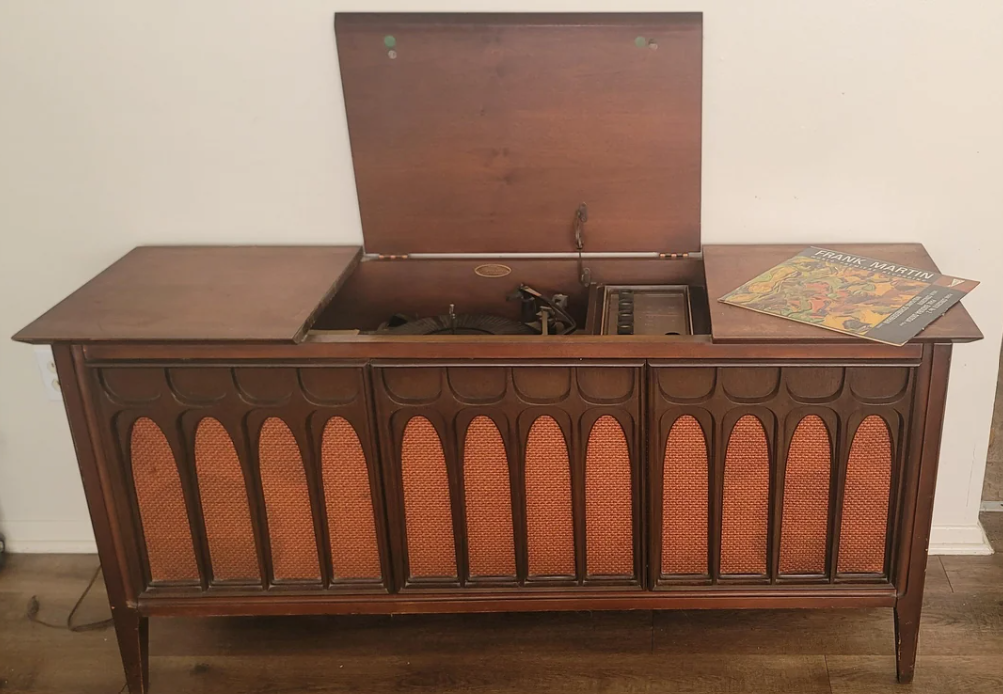
And also along the front wall was our Sears Silvertone console stereo record player and radio. There was a chair in the corner, to the right of the Siegler heater. Seems like there was another chair, with a high back, in front of the back living room window.
The room directly above the living room was “the other” bedroom. There were two beds in the upstairs bedroom. I think both of those beds were metal, and had metal chain link springs. I do recall a white chamber pot that was under one of the beds. Fortunately we didn’t have to use a chamber pot. Mom probably had, but we had indoor plumbing and a bathroom by the time I came along.
The upstairs had two rooms separated by the stairwell & a narrow hallway. One was used for a bedroom, but the other was a “junk room.” There was no furniture in this other upstairs room, but there was a large “steamer” trunk that had some interesting things in it. I played in this room and remember having a small cast metal howitzer toy that had a working spring trigger and you were supposed to shoot out small wooden projectiles. They may have been painted red, but I also used a straight pin and would force it into the green plastic soldiers I had. I was pretending they had been shot with an arrow.

I think I also played with my Tonka Cement Mixer up there also. This room had a back window which looked out onto the bathroom roof and the kitchen roof, which was higher.
About ten yards off the back porch there was a deep ditch that ran up to and underneath Queens Creek Road through a large tile pipe and then angling up almost to a point back at Highway 24. Nearest Queens Creek Road along the ditch bank was a pink Crepe Myrtle tree. Next to it was a thorny tree, and about 10 yard further there was a pomegranate tree. Next to the pomegranate tree was a narrow wooden plank which ran across the ditch.
At times there was only a trickle of water in the ditch, but at other times, after a rain the ditch would flood. In the summer, the ditch became overgrown with water plants, but there was also a clay bank near the pipe that ran under the road. This clay was a light gray color and it made excellent cannon balls. There was also a few crayfish that took up residence on this clay bank and built a tall muddy entrance to their home.
This is the corner of Queens Creek Road and Highway 24 as it is today (well, whenever the picture was taken by Google Maps. Years ago there were maybe six tall oak trees to the side and front of the house. They were taller than the Burger King sign shown below.

DON’T FORGET!
The Kitchen
There were two doors into the kitchen, almost side by side, accessible from the back porch. I don’t know why you would put two doors so close together, but it may be that at one time the kitchen and the dining area were separated by a wall, but there was no wall by the time I came along. The kitchen, with stove, sink and refrigerator, and I think a kitchen table were at the back of the house and there was a window directly behind the kitchen sink.
The was a separate dining table and a free standing wooden dish cabinet with a large glass door which was against the wall nearest the bathroom. As I said before, there was no direct passage between the kitchen & bathroom.
I recall working on school work at the dining room table. One time I had to write a several page report, or it might have been required to be at least a thousand words. I was totally lacking any ideas for what I could write about. I, or mom, finally found an article in the Readers’ Digest about the sinking of the Admiral “Graf Spee,” a German battleship off the coast of South America. It took everything I could muster to lengthen my story to the required length and I recall that the teacher, probably English, knew where I had gotten my idea from.
When I was a little older we were learning “New Math,” and using a base number other than 10. Years later I would realize that the Hexadecimal System was one form of this, and I understood that you would count in Hexadecimal from 0,1,2,3,4,5,6,7,8,9,A,B,C,D,E, to F. This meant you only had to use one digit to represent 16 numbers. But in elementary, or maybe middle school, I did not understand this concept and I failed the first test and the second test. This was something I just didn’t do, and I came home, got under the kitchen table and cried. I don’t remember which classmate came to my house while I was crying, but he caught me crying. It might have been Michael Gurba. It was probably middle school because he was able to come across Hwy. 24 from school, and elementary would have been several miles down in Swansboro. I think what I didn’t understand was when the teacher was using Base 5.
At the same table, I remember drawing a picture of a person. I don’t recall exactly what, but it may have been of a Boy Scout in uniform. I was using the light from a window that faced the smokehouse. I did sign up for a drawing course, or evaluations, from a company. I think it was called “Famous Artists Schools,” and they sent a booklet with various drawing tasks to perform. Once completed, you would send what you had produced back to the company and they would direct you to study according to your talents. I’ve doodled most of my life, even while taking notes in school and college, but I’m no artist.
When I was older mom bought me a wooden guitar and I took guitar lessons in Jacksonville on Saturday mornings. The lessons didn’t last long. I really had no musical talent, and I wasn’t dedicated to practice and then one morning my teacher wasn’t actually a guitar teacher, and my mom knew this from talking to her. No need to spend time & money on something that I had no talent for.
I think one of the songs I practiced for the guitar was “Paint It Black” by the Rolling Stones. “I see a red door and I want it painted black. No colors any more. I want them to turn black. I see the girls walk by dressed in their summer clothes. I want them to turn black, until the darkness goes.” Maybe not the lyrics perfectly, but close.
I kept the guitar, and finally in college, at Campbell (1975) there was a musically talented student who took my guitar and started to play something. I could tell this guy was a good guitarist, but my guitar was cheap and sounded awful. Not his fault, obviously. This might have been the same guy who performed a magic trick for several of us. He asked for a quarter to perform the trick and after the trick was over, he kept my quarter. Slick Dick.
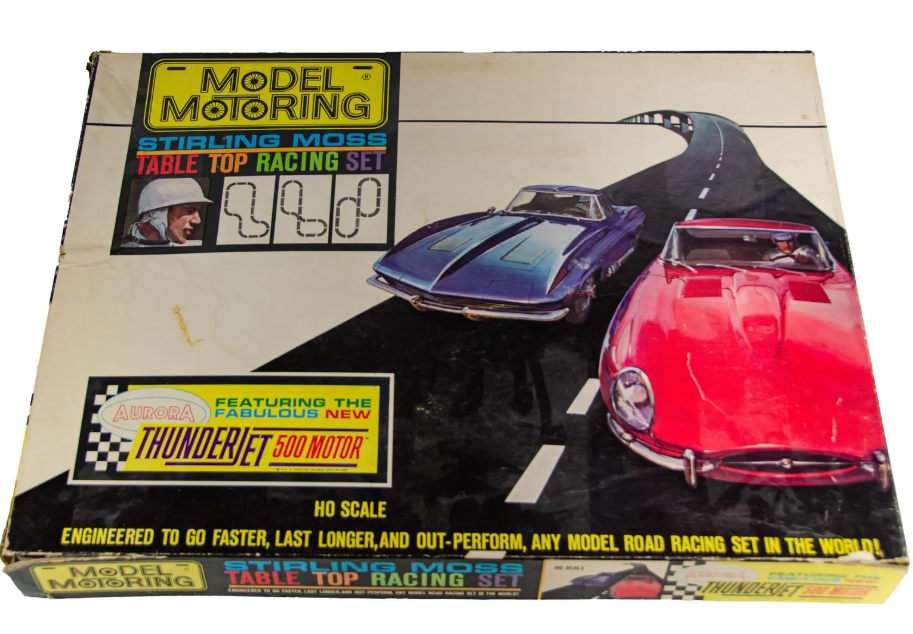

One Christmas mom bought me a small figure eight slot car track, an Aurora “Stirling Moss” setup. I set this up on the dining room table but I hadn’t played with the cars for very long before one flew off the track, and off the table and down onto the floor. When the toy hit the floor a piece of it, a “communtator brush” popped out of the bottom of the car.
This piece was a very small flat metal disk, a little bigger than a BB. Without this piece power couldn’t get to the slot car motor and therefore it wouldn’t run.
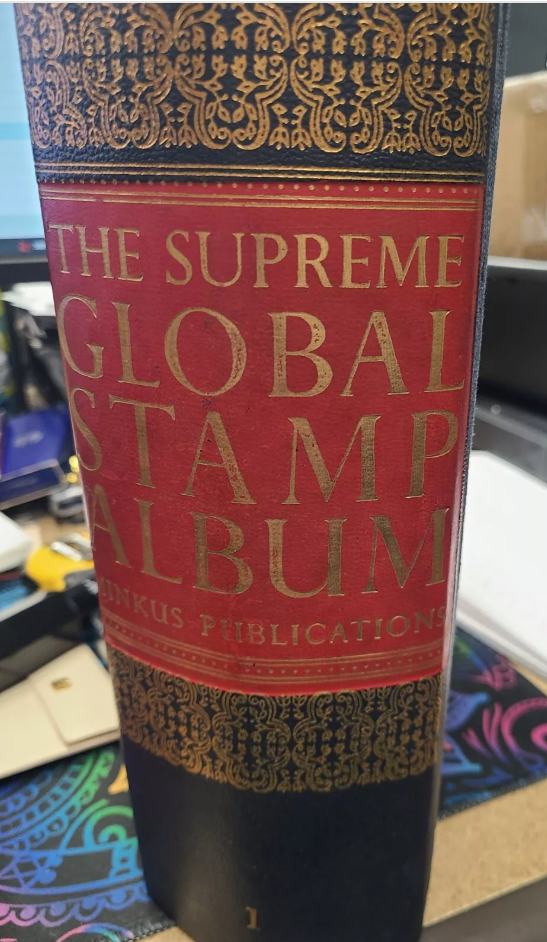
I’m not sure which Christmas I received the “Global Stamp Album.” When I got my album it was a single volume, and was probably about six inches thick. Each page was double sided and had full sized black & white images of the various stamps, categorized by country (not just the U.S.). Later I think the company printed more volumes and had more stamps per country. When you got an actual stamp, you would stick it with an adhesive hinge, on top of the black & white version on a page. The hinge would allow you to lift the stamp up to look on the back, although there was rarely anything on the gummy side of a stamp.
I ordered small bags of used stamps and would go through them looking for stamps that I might not have already. These stamps were not pristine and often not in very good condition, but you could always get them and then later get a better version, for possibly more money. Austria and Angola had pretty colored stamps. I recall going to a stamp dealer in Norfolk, Virginia. I’ve said this elsewhere, but downtown Norfolk is similar to downtown Chicago in that both are notoriously cold. *I might have gotten this album after mom and I had moved to Hubert to live with Aunt Sis (Carrie Kellum).
Years later, when I went off to Seminary in Louisville, Kentucky, I left this album in my attic at 204 Johnson Blvd. in Jacksonville, N.C. Wrong choice! When I got back someone had taken the album and I never saw it again. It may not have had many stamps of value, but it had quite a few stamps.
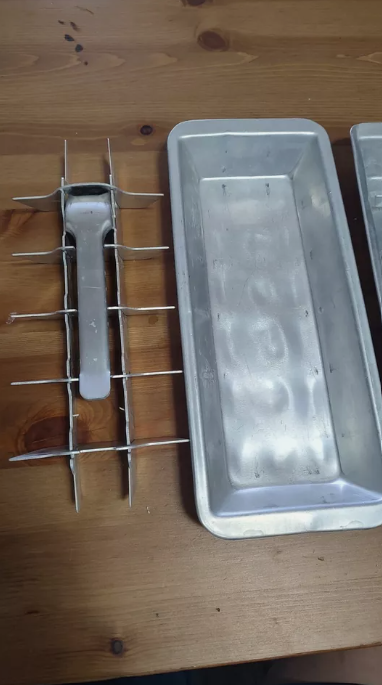
Iron rust in the kitchen sink
Below is not a kitchen sink, but the iron rust stains are exactly what we had to endure.

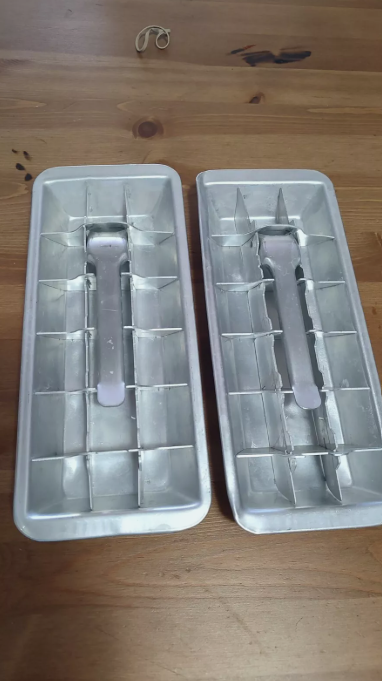
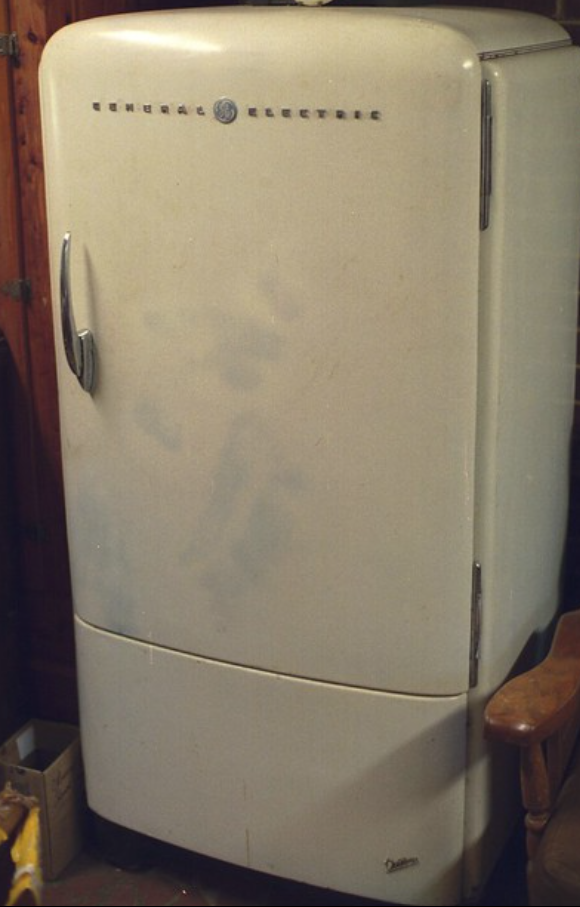
GE Refrigerator
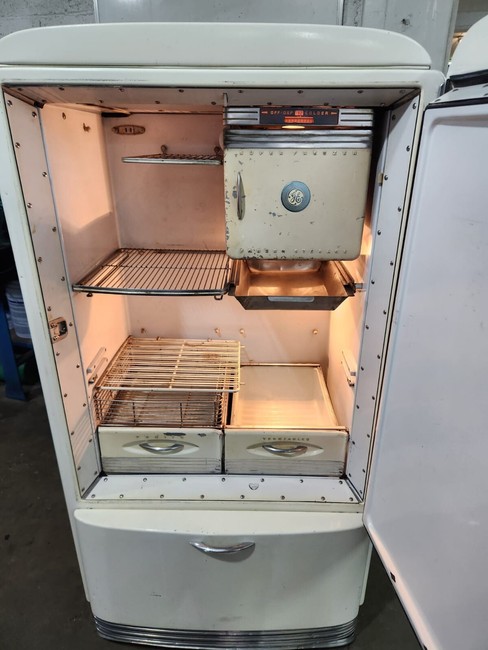
The interior of this GE Refrigerator is hauntingly familiar, but it was a long time ago.
Old glass doored china cabinet
Description of the master bedroom
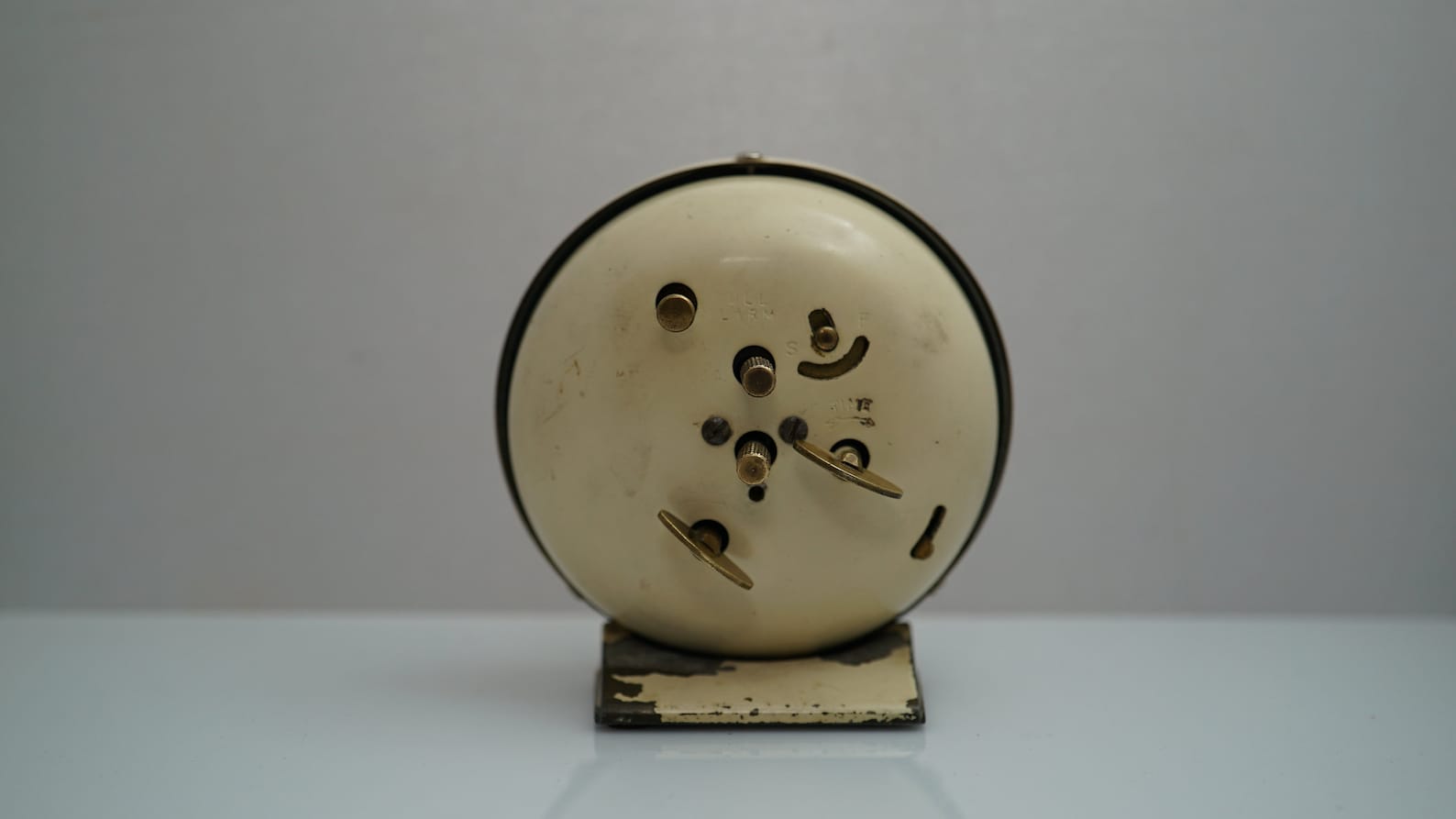
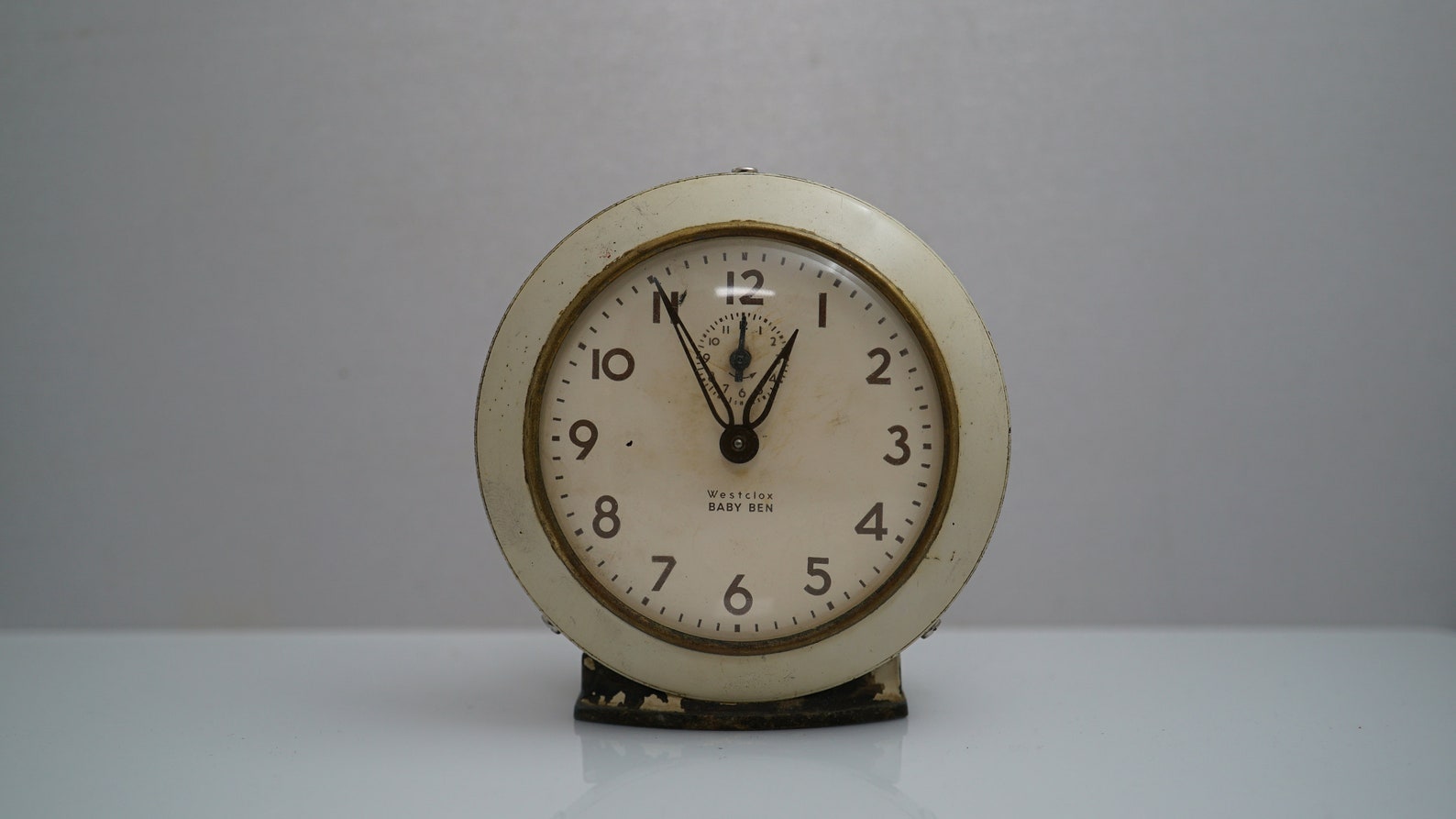
Little beige Westclox clock Baby Ben with flourscent hands. I don’t have the original clock, but a copy.
I was just looking at the picture of me, as a young boy, standing by our television set in our living room. These curtains were made of a fine, see through, mesh but each window had a “pull down” curtain. The pull down curtains were on a spring loaded roller, and at the base of the curtain there was a long, flat wooden dowel (Do dowels have to be round?). This wooden dowel provided extra sturdiness, but they could easily be broken in two. They were something to grab onto, to pull the curtain down. There was a spring mechanism on one end of the roller that tensioned a spring as the curtain was pulled down, but it then locked into place, leaving the curtain down. But with a quick jerk downward, at the bottom of the curtain, the spring mechanism would release and the curtain would rewind into it’s roll at the top of the window.
The roll at the top of the window was made of a wooden dowel that had metal end caps on each end. The metal caps had a protrusion that fit into a hanger attached to the wall with a nail or screw. The curtain itself was made of plastic. At least I think it was plastic. It was thin, but not transparent, and white in color.
The window frame and sill were usually painted white, a gloss white often. The old wooden framed windows fit loosely in the frame. Sometimes the paint would cause the window to stick in it’s frame, and you might have to use a knife or screwdriver to “break the seal” of paint. You could then raise the window, and lower it. I said the windows fit loosely in the frame and sometimes cold air would seep into the house around the bottom or sides of the windows. So in preparation for the cold winter months, you might get large sheets of transparent plastic and cover the outside or inside of a window. I don’t think we had duct tape then, but maybe used staples to fasten the plastic sheeting over the window. You could also put a rolled up towel along the base of the window to stop cold air from seeping in.
We lived close enough to the Marine Corps Base (Camp Lejeune) and when they were shooting their Howitzers for practice the sonic boom would shake the window panes. Just something that you would get used to. What is it? Near Seymour Johnson Air Force Base in Goldsboro, NC there is a sign near the front gate that says something to the effect, “Our noise, is the price of freedom.” Well, I guess the howitzer practice was a small price of freedom also.
Another short ditty I just thought of. One night my mother and I were standing on the back porch and we looked up into the sky and saw two lights, probably over the ocean, but the house was about a mile or so from the beach. Well these two lights flew through the air, and eventually came together in a point. I recall that it reminded me of a simple drawing of a fish. The started out at two corners of a fishes tail, then came close to each other and then arced away from each other forming the larger body of the fish and finally coming together at the mouth. Fish have noses, but they don’t usually stick out further than their mouths. Neither mom nor I knew what these lights were. Many years later, I read something about target practice with missiles and figured that the Marines had been practicing shooting other flying objects. Or not.
These stories are definitely not in chronological order, but her goes another one. I had gotten a bow and arrow, not sure if it was a Christmas present or not, but one sunny day I was out in the yard playing with this toy. The arrows had simple metal tips, not like the flanged hunting tips that are meant to kill, but not something that you want to be pierced with either.
I walked over the wooden plank that traversed the ditch and was in the field/pasture (we no longer had the mule by this time) where the Pack House was located. So, there is really nothing nearby to shoot at, the pasture is plowed but stubbly stalks are sticking up from the ground. All of a sudden I get the idea to shoot an arrow straight up into the air, as hard as I can. I pull back on the string and let go and the arrow quickly disappears into the sky. There was very little wind that day. I waited a second or two and then an awareness came over me. Whatever goes up must come down, and I don’t want that arrow to come down on top of my head. I couldn’t see it so, I took off running as fast as I could. Now if you think about it, it was as probable that I might run exactly where it was going to come down, so standing exactly where I had let it go might have been as prudent as running. The arrow came down about 15 feet from where I had been standing, and I had ran even further away in a different direction, but the arrow did stick in the ground. I didn’t make that mistake a second time.
I’m not sure where I got a moped, and this was one of the early vehicles made with a tubular metal frame, a lawnmower type engine and fat tires. Maybe it was someone else’s bike and they had loaned it to me. I didn’t have the sense to mechanically work on bikes so it wasn’t like I was going to tear an engine apart, trying to soup it up, and getting severely greasy in the process. No in this case I got it from “I don’t know who or where,” and I was just riding it. I happened to be across Queens Creek Road from the old house, but on our farm and was riding down a sandy unpaved path. You’ve probably seen those types of paths. The grass is worn where automobile tires roll, but the median (middle) has grass growing in it. Well I got to the end of the path where I needed to turn the moped around and it was taking a greater turning radius than I had imagined. The problem was beside this path was a deep drainage ditch. This ditch was part of the same drain system as the ditch that ran behind our kitchen, but it was deeper in order to drain the corn/tobacco/soybean fields on our farm. As I turned, the fat tire came extremely close to going into the ditch. I would have been severely hurt if it had. But, having come so close and realizing how lousy I was at controlling this bike I decided to stop riding it. It wasn’t worth the fun to get dead.
*Mom leased the farm out to a man I called “the Fat Farmer.” His actual name was Frank Howell, and he did have a large belly. He rode around in a big, extended cab truck with his window rolled down. He leased several farms to make it profitable and he would go from farm to farm, usually staying in his truck but talking to his “farm hands.” The lease was based upon the tobacco allotment for our farm, and he would pay us $3,000 at the end of each year. He paid nothing else for any other crops he might grow, but through the years I know there had been corn, soybeans and the “money maker” tobacco grown in our fields. We had two tobacco barns on the farm side of QCR and the pack house on the opposite side, the same side as the old house. One of the tobacco barns burned down and wasn’t rebuilt. The one that burned is shown in the picture way above in this article, with me on the back porch, with my bicycle. If you look closely you see the mule, who is on the other side of the ditch from the kitchen and in the same pasture as the pack house. But beyond the mule you see a tobacco barn, which is diagonally across Queens Creek Road.

In that same picture, you can see the little “lumberjack” cabin that Lyde had lived in, or might still have been living in at the time. Yes, because she died in 1962 and this photo taken by Mary Ann is 1960. I call it a lumberjack cabin because that is what it was used for. Forestry guys that lived out in the woods and needed a place to stay close to their work had little cabins like this. Big enough for a single bed, a few belongings, and in her case a hot plate or heating water. Lyde, like Buddy, and even Sis all had tuberculosis at one time or another so she had to live apart from he rest of the family. I don’t know what they were thinking because she was in close contact with all of us at some time or other.
I’ve shown positive for TB ever since I was a boy and had been exposed to it from these other family members. If they gave me that TB “prick” test, the area infected would always be about the size of a quarter, and they would ask me, and I would tell them my story of a family in which several members all had TB at one time or another. Buddy having died from it’s effects.
Seems like you can get it under control, if you are healthy, but when your health starts to fail, TB can return and become a terminal health threat. Wouldn’t that be a hoot?
Not often but at least once a year my mom and I might walk the far farm road at the back of the fields. This road was unpaved and went from the fields into the piney woods, heading over to Hammocks Beach Road. This road is where the new Swansboro High School is located. There were two things of note over in this area. Along the road, and sometimes in the median, you could find a Sassafrass plant growing. They had a thick woody root that you could take and boil to make Sassafrass tea. I recall it had a good flavor, if you put a little sugar and cream in it, and had a slightly pinkish hue.
The other item of note that was located in the woods, at the edge of where our farm met someone else’s field, was a “tarkle bed.” At least that is what mom called it, and that was because her parents had called it a tarkel bed. It was many years after my mom had died (in 1980) that one day it came to me what a tarkle bed actually was. You see is was a large mound of earth that formed a giant bowl, and mom said it had been used to cook down pine trees to make tar. Does this seem to become familiar? After all, we are the Tar Heel State. During the days of “wooden ships,” they used tar or pitch to seal the cracks between the wooden planks that formed the ship’s hull. It was a profitable business. So, it came to me that a tarkle bed was actually a “tar kiln.” I just googled for both “tarkle bed” and “tar kiln” and the tar kiln definition is spot on to what I’ve described above, with the mound of earth, etc.
I haven’t checked with anyone, but I am guessing that when they built the new Swansboro High School, they destroyed this mound of earth, when instead they should have cordoned it off and made a monument to it’s former use and State status.
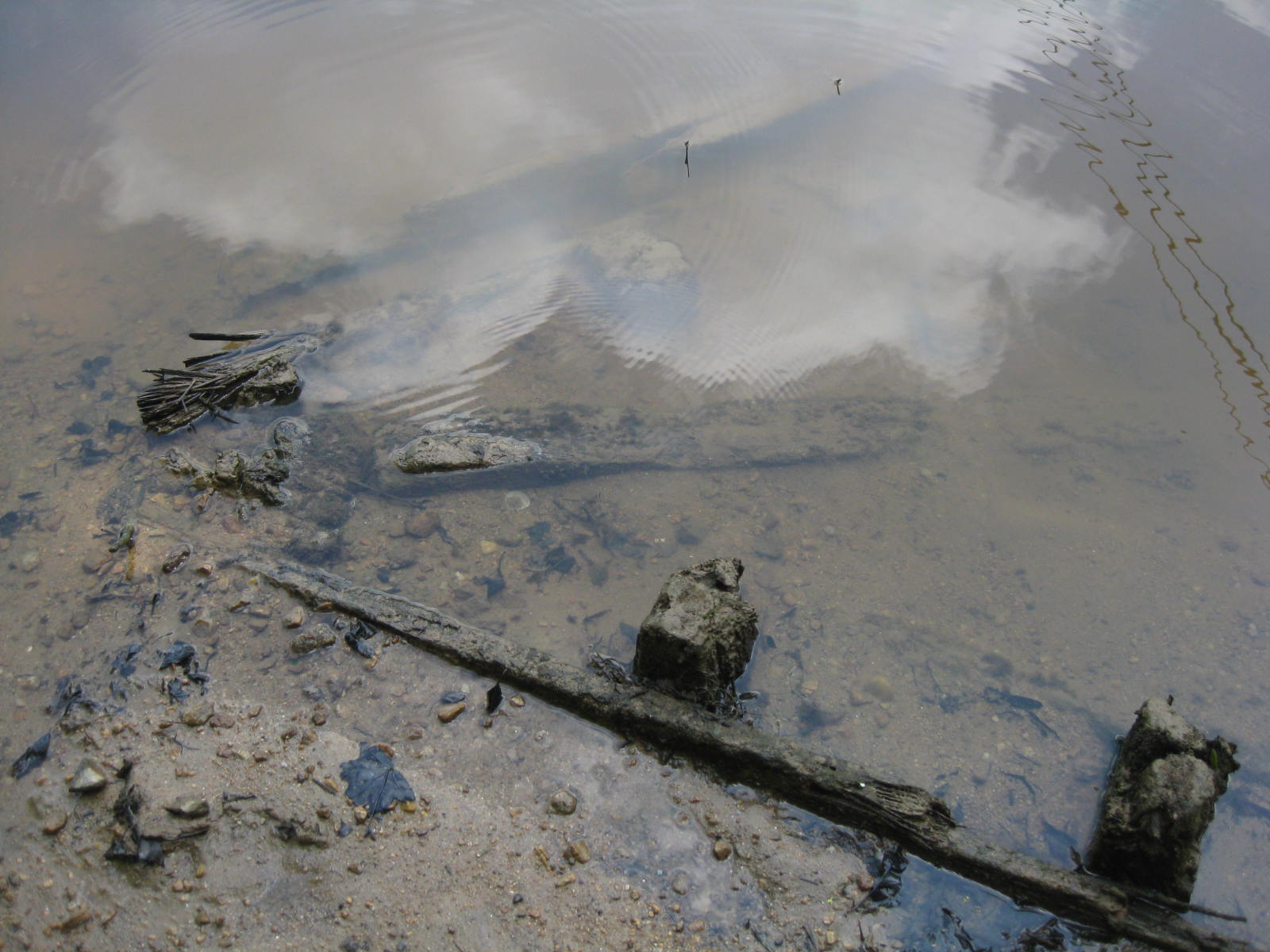
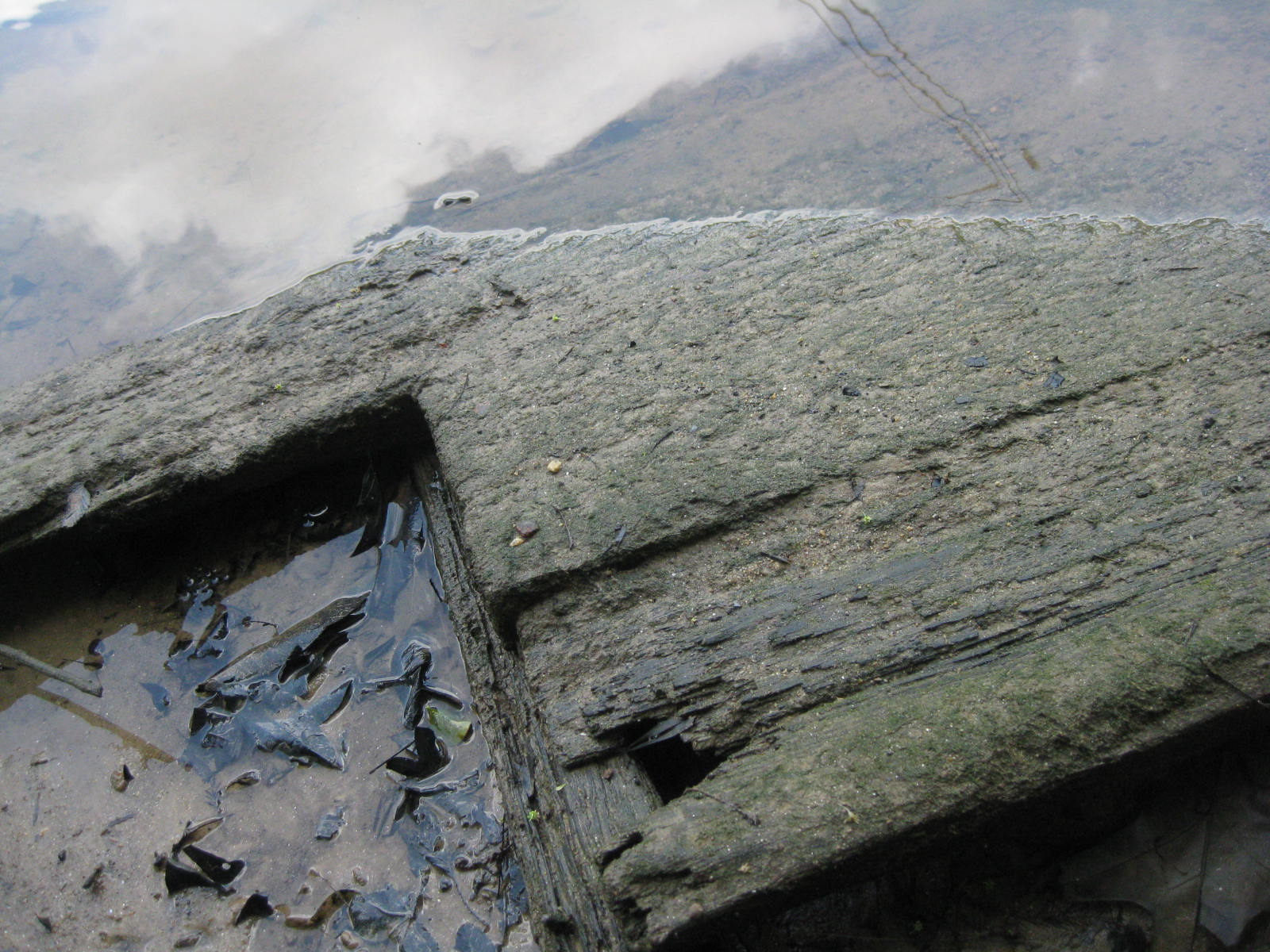
Recall that when they were dredging the Cape Fear River down beneath the bridges at Elizabethtown, they dug up the remains of the Thelma, the last paddlewheel steamer on the Cape Fear River. But several years before she was completely gone, I did stand on a part of her deck when the river was low. *I thought the photos had been removed, but no, they are still there.
 Bill Gibson, II